Burin
Lumen & Logic
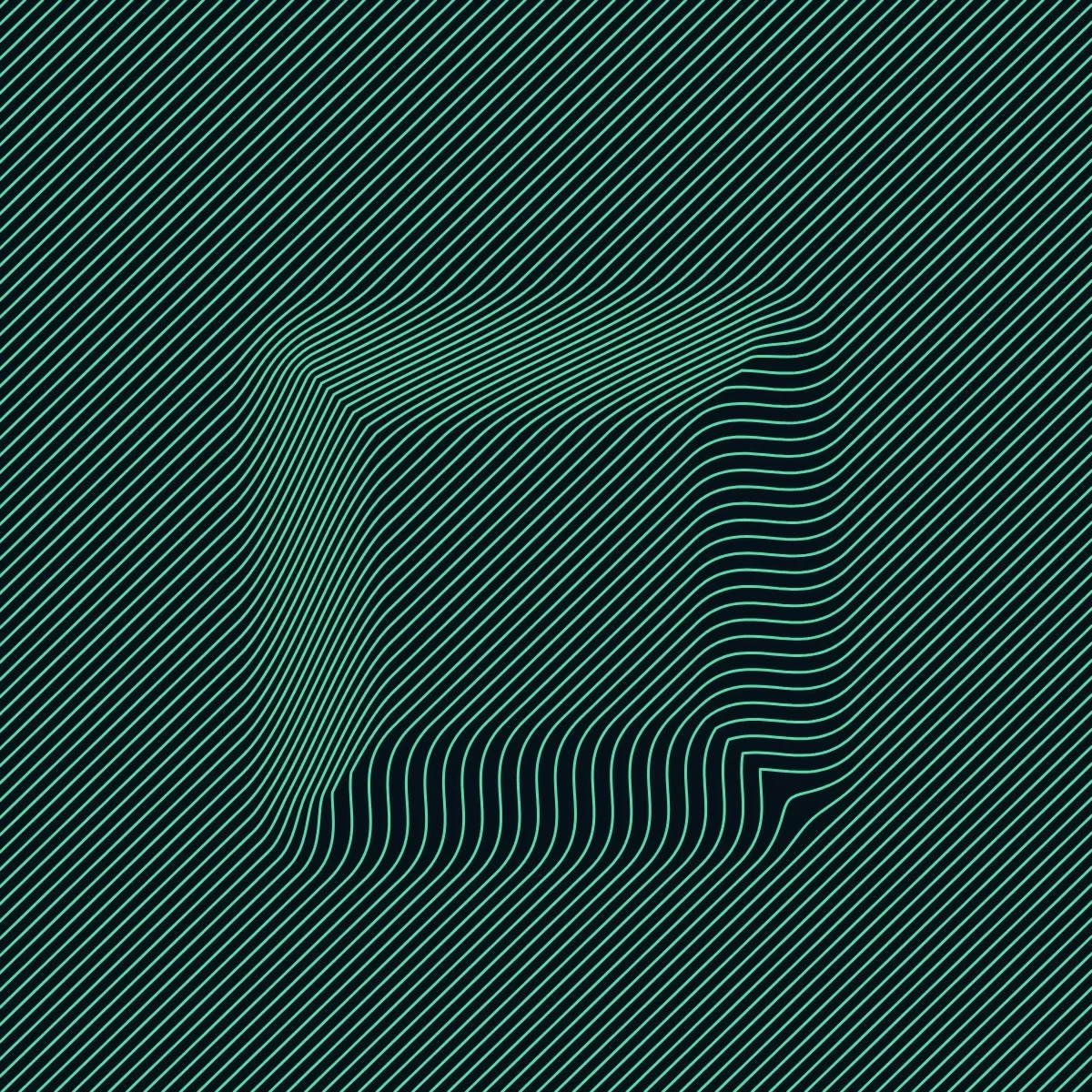
One family of fine lines on a dark plate, straight 45° hatching in the corners and swung round into vertical runs and terraced staircases where a shape the picture never draws disturbs them. There is one scalar field and one pen: the field is a linear ramp — the grating — plus a compactly supported bump over the element, and every line is an integer level set of it, so nothing anywhere is clipped, masked, offset or cut, and no line ends inside the frame. The whole behaviour of the picture is one dimensionless number, the relief number R, which is the bump’s slope measured against the grating’s: the maximum turn away from the base direction is asin(R), spacing runs between T/(1+R) and T/(1−R), and R < 1 is exactly the condition for the phase to have no critical points — which makes the family a foliation, so lines cannot cross, cannot branch and cannot close into islands. `Relief` is that number as a percentage of the bound and the amplitude is solved from it rather than set, which is why the knob sweeps end to end without ever tangling; the failure at the top is not crossing but splaying, since crowding is bounded at twice the base density while thinning is not bounded at all. Tone is spacing and nothing else — one ink, one width, no shading pass anywhere — and the terraces along one pair of sides and the smooth vertical runs along the other are the same turn seen ninety degrees apart. The element is a knob and every one of them is an exact Euclidean distance function, because it is |∇d| = 1 that turns the bound into a formula instead of a search: rounded square, disc, stadium, ring, hexagon, cross, or one per seed. The profile is a knob too — a plateau with a soft shoulder, a bevel that creases at both ends of its ramp, or a ridge that puts the welt on the outline and leaves the interior flat.
- Medium
- Generative algorithm, archival pigment print
- Dimensions
- 90 × 90 cm