Camber
Lumen & Logic
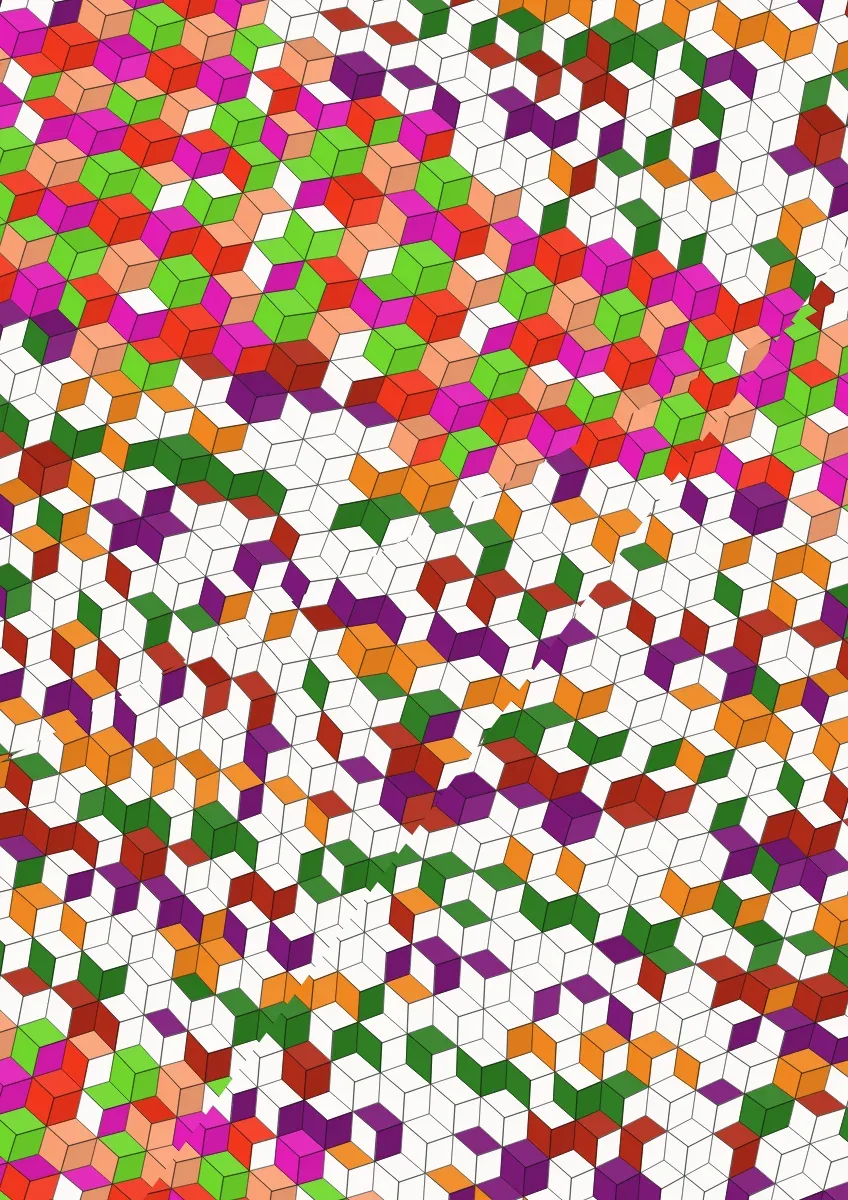
A full-bleed quilt of isometric blocks laid on a sheet that has been bent and cracked. Every mark in the picture is one rhombus of a single rhombille tiling whose vertices are integer points of a triangular lattice, grouped three to a hexagon so each block reads as a cube with a top, a left and a right face; because two rhombi that share a corner compute it from the same pair of integers, the tiling is closed by construction rather than by tolerance. A smooth two-octave displacement field then moves every vertex as a function of where it lands on the sheet, so rows bow and local scale drifts and no amount of bending can open a seam — and because the field is read in sheet coordinates it is one camber for the whole picture. Two or three straight faults cut that sheet into shards, and each shard carries the quilt with its own offset and its own fraction of a degree of turn: nothing is ever drawn along a fault, so the seam is only where one clip ends and the next begins and the rhombi on both sides are simply cut. Colour answers to two authorities that disagree. The deal — which face is left as paper, which ink it takes, which element the block is — is a pure function of the block's lattice coordinates, so it belongs to the quilt and slides with it across a crack, and because the ink index is linear in those coordinates the field is streaked with faint ribbons of one hue running along the lattice's own directions. The register those inks come from — a quiet palette that leaves half its faces white, or a hot one that leaves almost none — is a function of the block's position on the sheet, evaluated once at its centre, so a broad diagonal band of hot, dense colour runs straight through the faults the quilt jumps and its ragged edge never cuts a block in half. A block is filled five ways — the three rhombi of a cube, the same three lit from the other side so it reads as a socket, the hexagon as one flat slab, six triangles as a pinwheel, or each rhombus split on its long diagonal into a faceted gem — and every one of them fills the same hexagon, so the tiling stays closed whichever is chosen. Flat fills and one hairline of ink around every face: no gradient, no transparency, no blend mode, no shadow, no texture, no jitter, and nothing in front of anything else.
- Medium
- Generative algorithm, archival pigment print
- Dimensions
- 64 × 90 cm