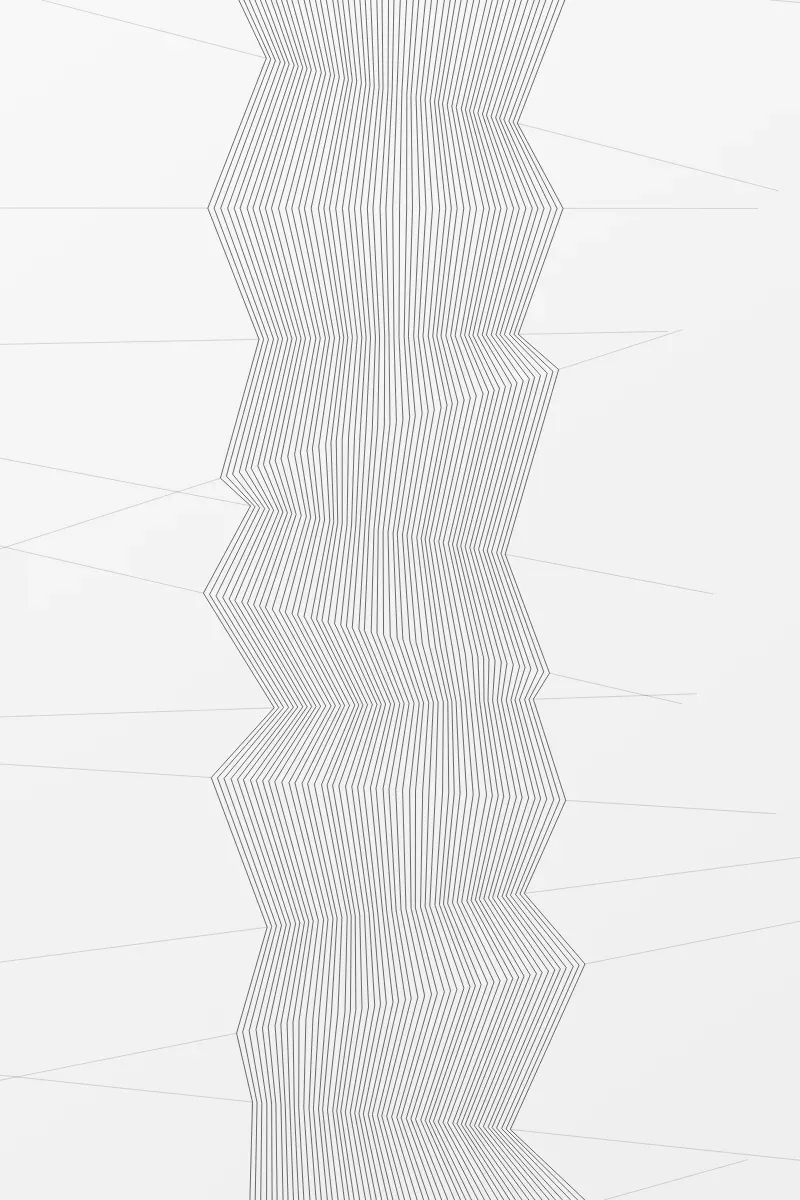
Chine
Lumen & Logic
A chain of straight creases, seen only through the threads that cross them. A chine is the hard fold line of a hull, where two plates meet — a sheet bent and never stretched — and there are a dozen of them here, each a plain segment, alternately short and long, tilted independently and stacked from above the frame to below it. Nothing draws them. What is drawn is a bundle of fifty-odd fine threads, and the whole of their geometry is one law: every thread meets every crease at the same fraction of that crease’s length, and the fractions are evenly spaced. That is the entire construction, and everything the picture appears to contain is a consequence of it. The chain of lozenges is the short creases pinching the bundle and the long ones letting it out. The nested chevrons are nothing but tilt: a crease lies at an angle, so the threads bend at staggered heights, and a staggered row of bends in a dense parallel bundle reads as an arrowhead. The dark crossings are two creases disagreeing about their tilt. Because the threads are ruled between consecutive creases, they can only cross if the quadrilateral those two creases span folds over on itself, so one orientation test per pair — damped, never rejected — guarantees that no two threads in the picture ever meet, at any count, and that every one of them runs unbroken from the top edge to the bottom. The creases are left visible the way a setting-out line is: each is drawn on past the bundle to the frame at a quarter of a thread’s ink, and never inside it, so the faint greys wandering through the empty paper are the construction itself and their crossings fall exactly where the geometry says they must. Everything is straight. There is no curve, no shading, no depth and no second ruling.
- Medium
- Generative algorithm, archival pigment print
- Dimensions
- 60 × 90 cm