Cloison
Lumen & Logic
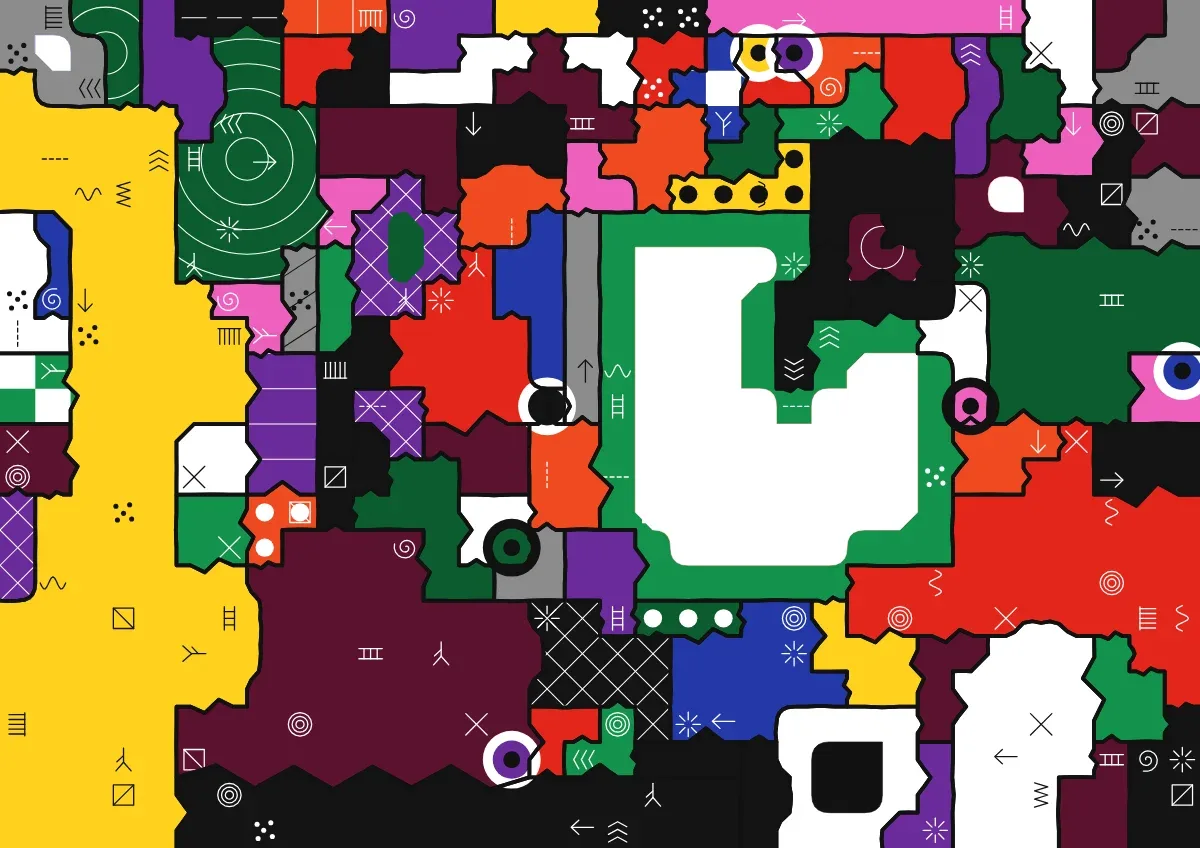
A full-bleed painted wall carved into interlocking flat-colour cells behind one heavy black keyline. The sheet is a grid, and every cell of it is owned by exactly one region, so the regions are a partition with no ground, no gap and nothing in front of anything else — the keyline is the partition itself rather than an outline drawn around a shape. The regions grow two ways. A limb is a thick self-avoiding walk that runs, turns square and runs again, dilated to a constant width and cut dead by the frame where it runs off; a lump is a compact competitive growth into whatever the limbs left, and a final sweep gives any sealed-off pocket a region of its own, so every cell is claimed by construction. Each region is then traced into closed loops, and every boundary decoration is a pure function of the boundary rather than of the region: a maximal straight run of seam is dealt a shared curve — bowed into a soft lobe, cut into a balanced sawtooth whose points fit their sockets exactly, or left straight — and each corner where exactly two regions meet is dealt a shared fillet, so one side’s rounded convex corner is the other side’s concave one struck on the same arc, and a small hand-wander displaces both sides of every seam identically. Because the two owners of a seam compute the identical curve from the identical key, the wall can grow lobes, teeth and a painted wobble and still tile the sheet exactly: whatever the alphabet does, it only moves area from one side of a shared line to the other. Colour is dealt so that no two neighbours repeat, with one exception — the mass colour, which is allowed to touch itself and so fuses into larger black areas. A minority of regions carry an echo, built by eroding their own cells by one and tracing again, which is why it follows every turn of the outline, pinches out in a narrow arm and sometimes breaks into islands; a minority carry a coarse dressing on the wall’s own grain — checker, dots, stripes, sawtooth rows, dashes, cross-hatch or rings; scattered cells carry one of fourteen hand-drawn marks, squiggles and tally combs and spirals and ladders and boxed crosses, each sitting inside its own cell so it can never cross a seam; and a few regions are handed an eye at their far end, which is the only figuration in the picture and turns a bent limb into an animal. Flat opaque fills and one keyline weight: no gradient, no transparency, no blend mode, no shadow, no texture and no depth anywhere.
- Medium
- Generative algorithm, archival pigment print
- Dimensions
- 90 × 64 cm