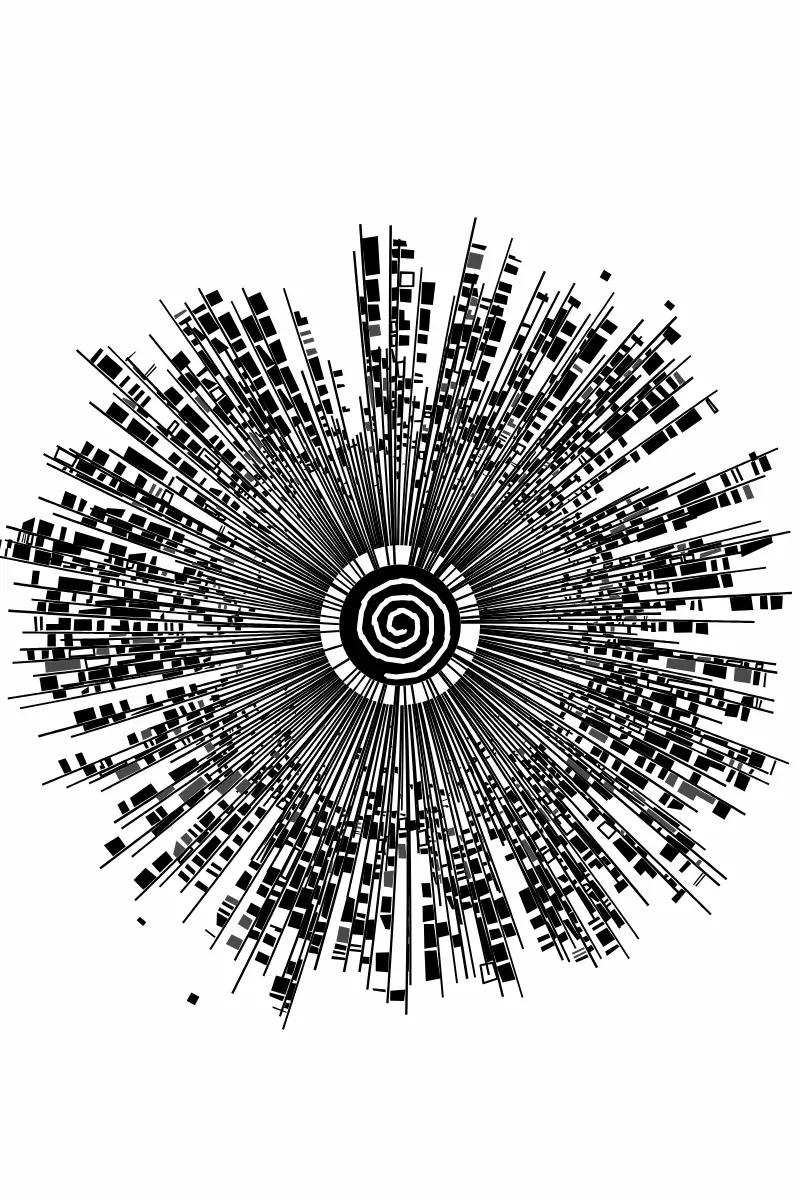
Fascicle
Lumen & Logic
A bundle of about two hundred straight rays leaves a small inked core in a jittered ring and can only thin outward: every ray is laid at the origin, none is ever born in the field, and each simply stops at its own radius — roughly a third of them early, in the middle of the sheet, and the rest together at the rim with a ragged, independently drawn edge. Each surviving ray owns the channel between itself and its next surviving neighbour and fills it with a ladder of short black slabs: the gap between slabs is fixed, the slab swells from a tick near the core to its full length two thirds of the way out and shortens again at the rim, and each slab reaches most of the way across its channel, so a slab is a rung rather than a dot. Every ladder has its own phase and its own draws, which is why the sheet has texture and not concentric rings — the rows the eye insists on seeing are not there, and the correlation between neighbouring ladders is indistinguishable from the correlation between ladders half a turn apart. Because a channel runs to the next ray still alive, the survivors’ slabs widen into the space the dead rays leave and the sheet stays covered as the bundle thins, capped so that no slab spans much more than its nominal share. The heavy black annulus around the core is not drawn: it is where the rays are closer together than their own width. So is the ragged outline: it is two hundred independent draws from one distribution and nothing else.
- Medium
- Generative algorithm, archival pigment print
- Dimensions
- 60 × 90 cm