Flash Sheet
Lumen & Logic
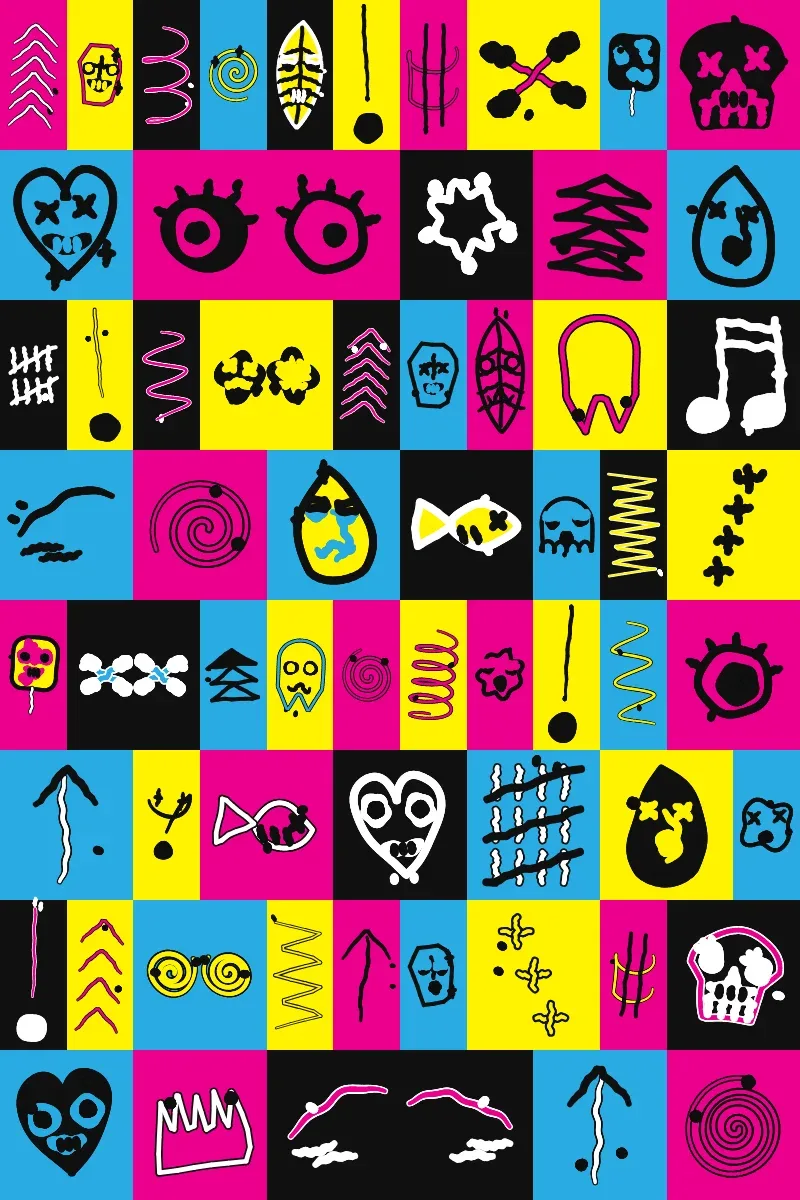
A tattoo-flash sheet of bold marker doodles on a tiling of flat process-ink panels. The sheet is cut into equal rows and each row independently partitions one shared column grid into butting panels — no gutters, no rules, no margin — so panel edges never line up between rows; the panels are then four-coloured from a locked process set so no two sharing an edge carry the same ink. Every panel hosts exactly one doodle, and every mark in every doodle is made by a single operator: a skeleton polyline swept at a width profile and replayed as a stack of concentric passes at decreasing widths in alternating inks, so a solid shape, a hollow outline, a double-lined mark and a plain one are four settings of one pass stack rather than four routines. The inks in that stack are resolved from the panel underneath rather than from the motif — the keyline is black unless the panel is too dark for black to read, judged as a perceptual lightness gap — so a motif never knows what colour it is and the same doodle comes out dark on a cyan panel and light on a black one. Thirty-odd subjects across three families draw from that one nib: swept strokes (zigzag columns, coils, squiggle trains, tally runs, chevron stacks, arrows, spirals, bangs, queries, dollar signs, plus-chains, note clusters, asemic script ribbons, starbursts and swooshes), closed bodies (skulls, ghosts, blobs, hearts, gems, coffins, flames, leaves, eyes, fish, clouds, teeth, splats, crowns, popsicles, bones, nested triangles and stacked discs), and a face kit of five eyes against five mouths dropped into the ambiguous ones to turn a shape into a creature. Each subject declares the panel proportion it wants, so narrow strips get tall subjects and square panels get compact ones and nothing is ever stretched to fit; each is fitted by a uniform transform that solves its own tilt, and a few adjacent panels merge into diptychs carrying the same subject twice, mirrored, in swapped inks. Every stroke is heavy, round-capped, tapered at free ends and hand-wobbled by the same amount relative to its own panel, so the whole sheet reads as one sitting. All grounds are painted before any mark and every mark is fully opaque: depth is occlusion alone, with no gradient, no transparency, no shadow, no texture and no type anywhere.
- Medium
- Generative algorithm, archival pigment print
- Dimensions
- 60 × 90 cm