Furl
Lumen & Logic
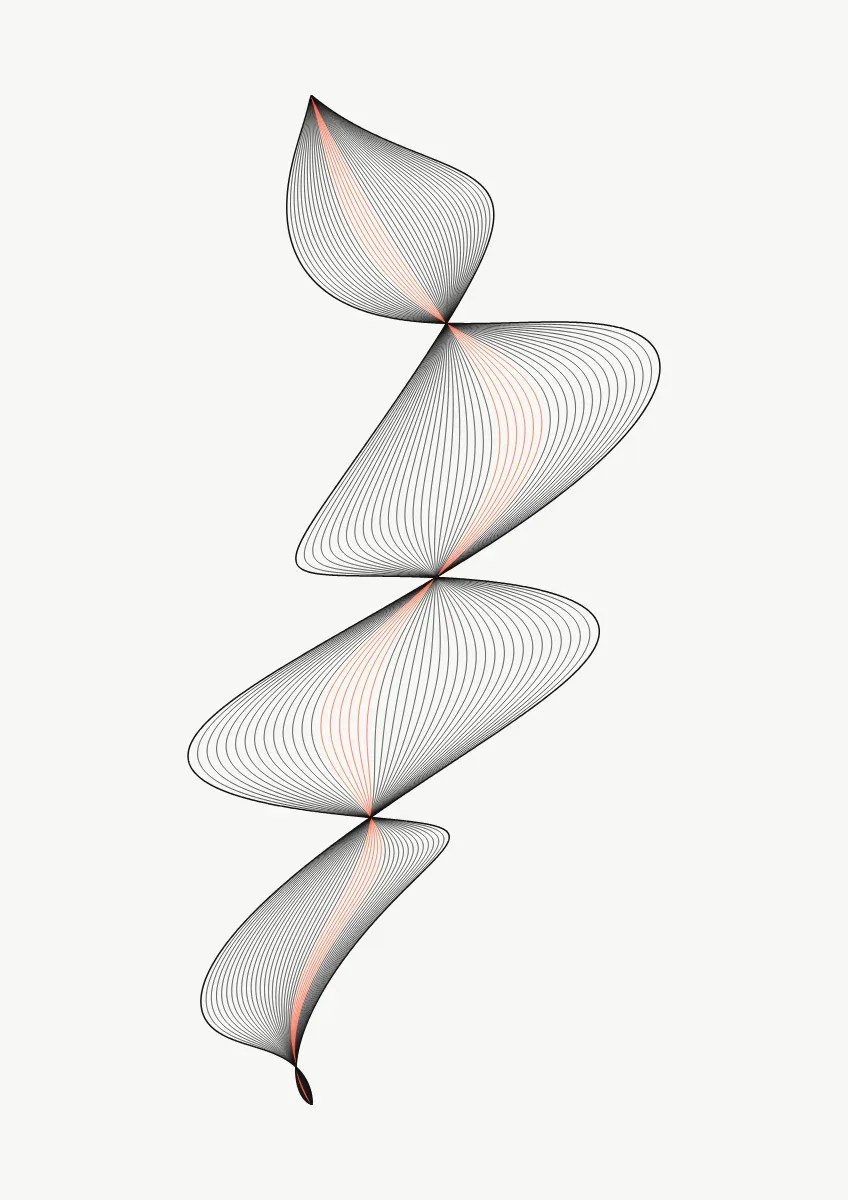
One strip of paper, twisted along its length and drawn flat-on with a single nib, as nothing but the tracks of a few dozen points fixed across its width. A point at cross-coordinate s lands on the spine plus s times the strip's half-width times the cosine of its twist angle, and four of the picture's most characteristic features are that one formula rather than anything drawn: where the twist carries the strip edge-on the cosine passes through zero, so the projected width vanishes and every track meets at a single point on the spine; past that pinch the cosine has changed sign, so the whole strip has turned over and the coloured stripe running down it appears on the opposite edge without ever moving through the lines between; the gap between neighbouring tracks is the projected width divided by the count, so a nib of one constant weight covers a larger and larger share of the band as a pinch approaches and the passage goes solid black by crowding rather than by fill; and where the band passes across itself, which part is in front is decided by depth, the band being cut into lobes at its own pinches and painted back to front — a cut that costs nothing, because two lobes meet exactly where the width is zero. The twist is a total turn rather than an amplitude, so every hundred and eighty degrees adds exactly one pinch and the knob is the lobe count in disguise, while a seeded reparametrisation makes the lobes come out uneven without ever changing how many there are. The strip cannot cusp: its half-width times the spine’s curvature is bounded below one once, globally, so no track can cross another and the package carries no collision test, no clamp and no retry — past a point, wandering further narrows the band instead. The track itself is drawn four ways: a plain line, a line whose weight follows the strip’s own foreshortening so the pinches stay crisp, a chain of beads sized from the local gap so they shrink to nothing at a fold and can never touch across the band, or a line broken on a rhythm that is a function of length alone, so the breaks line up across every track and a cross-band ripple appears that nothing draws. Line only — two inks and the bare ground, no gradient, no transparency, no shading, no shadow and no texture, and no outline other than the strip’s own two edges.
- Medium
- Generative algorithm, archival pigment print
- Dimensions
- 64 × 90 cm