Gnomon
Lumen & Logic
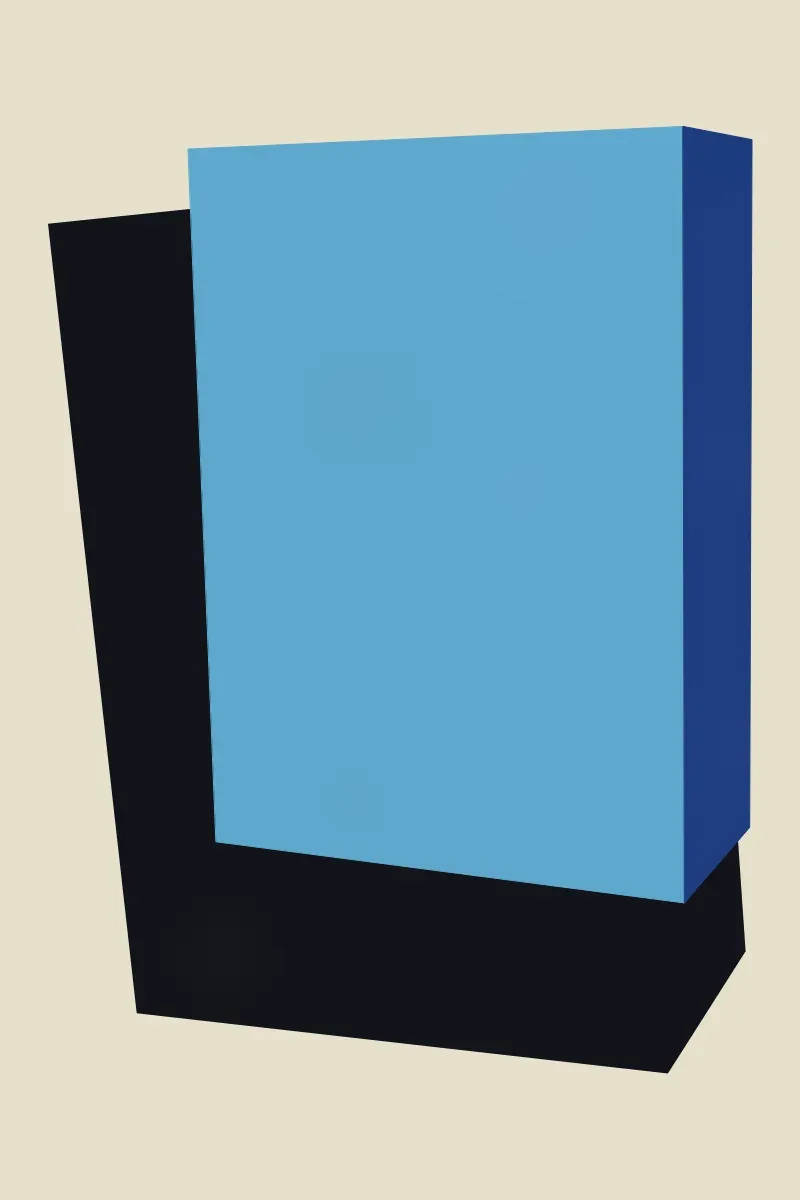
One monumental solid on bare cream, after a hard-edge painting of a blue slab: a light face square-on to the viewer, a darker face raking away down its side, and one black mass behind it that hugs its lower edges and closes to a sharp point above its shoulder. There is one solid, one lamp and one lens, and every mark is a consequence of those three rather than a shape that was drawn. The reference is a correct perspective projection of a box — extending its two horizontal edge families gives vanishing points that fit a pinhole camera to within a degree — so this builds a real solid and a real camera instead of nudging the corners of a quadrilateral. The black is not the blue offset a little: a translated shadow keeps every edge parallel to the edge it came from, and in the reference the slab's left edge and the shadow of that same edge lean five degrees apart. It is a real cast shadow instead — a point lamp, a wall behind, and the solid projected onto it — with the lamp solved in closed form from the two things a picture actually shows, how much bigger the shadow is and how far it is thrown, rather than positioned by hand. One thing physics will not do, and the package says so rather than hiding it: a box's shadow edges are always parallel to the box's own, because an edge at constant depth takes a constant magnification, so an honest black is a rim of uniform width. The reference's tapers, from 22 % of the slab's width at the top to 13 % at the bottom. So the black is cast from the same solid turned a few degrees about its own centre — the rotation put where a painter puts it, in the caster rather than in the physics, and it goes back to an honest shadow at a cant of zero. One primitive builds every element: the convex hull of two parallel convex polygons, the upper a scaled copy of the lower — which keeps every side face planar, makes hidden-surface removal a sign test per face, and means the visible faces tile the silhouette exactly, so nothing is ever sorted or depth-buffered. The tone of a face is an index into the palette and never a tint of one colour, because the reference's two blues are two different blues rather than one blue darkened; and the ladder is keyed by how squarely a face meets the viewer rather than by the light, which is the poster convention the painting follows and not the physics. The frame is fitted to the solid and its shadow together, so the solid drifts off centre away from the lamp on its own. The element is a knob — slab, wedge, chamfered block, pentagonal pylon or faceted column, any of them battered or flared by a taper — and it is nothing but the list of convex bases the same camera and lamp run on.
- Medium
- Generative algorithm, archival pigment print
- Dimensions
- 60 × 90 cm