Gradine
Lumen & Logic
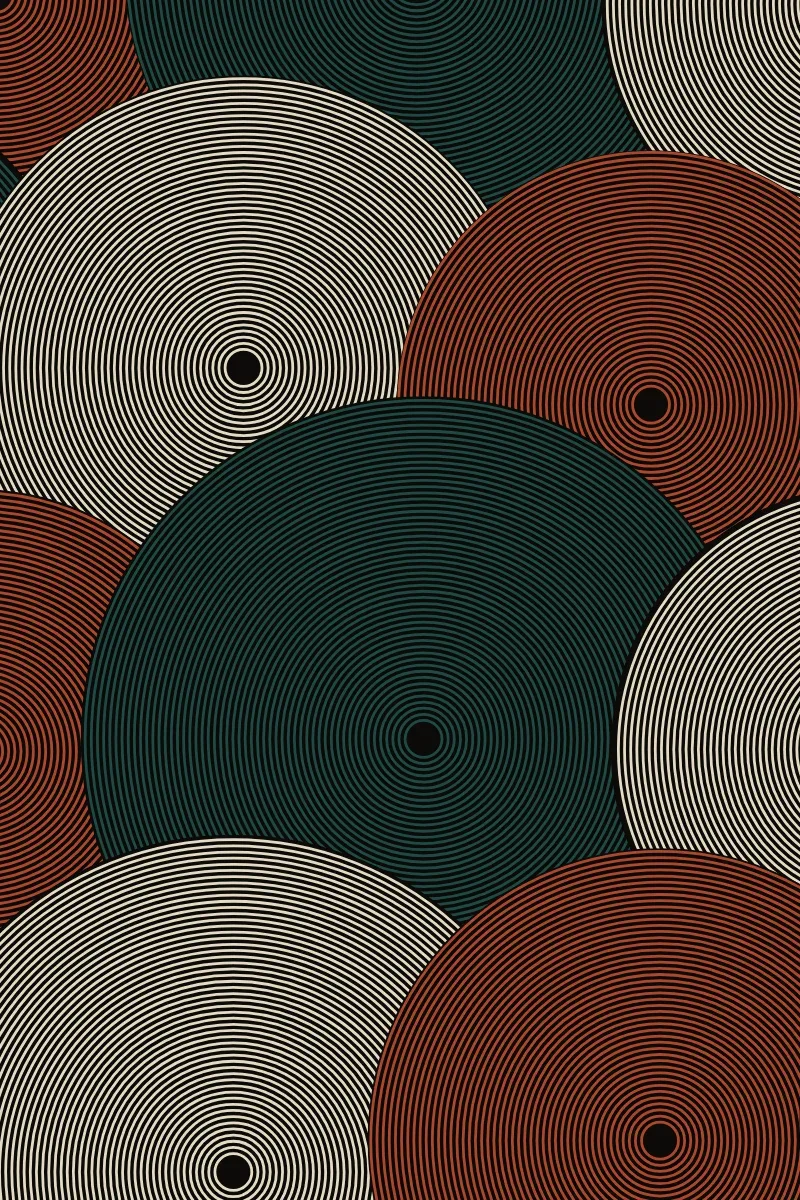
Large overlapping families of concentric rings on black, in three flat inks, where every mark on the sheet is one step of a single ruler and the only thing that changes across the picture is which centre a mark is measured from. The ruler is one number — the sheet’s short side divided by a count — worked out once before any disc exists and never worked out again, so a ring lands at an exact multiple of it and nothing anywhere derives a spacing from the family it belongs to. The consequence is the picture: a big family carries more rings than a small one and never wider ones, and the corduroy runs on at exactly the same gauge across every seam even though the centre it is struck about has jumped, so the sheet reads as one material that has been re-centred rather than as several laid side by side. The black eye at a family’s middle is not an object but the handful of steps the ruler skips, which is why it is the same size in the largest family and the smallest; and because a radius is not a whole number of steps, every family ends on a leftover — a black annulus between its outermost ring and its true edge, a different width in every one of them, that nothing draws. Centres sit on a triangular or square lattice and take their ink from arithmetic on the index alone: site (i, j) is coloured (i + 2j) mod 3, so no two adjacent sites can share an ink, with no search and no possibility of failure. One inequality then carries that from the lattice to the picture — the largest radius plus the largest centre displacement must not exceed half the lattice’s second-neighbour distance, and the radius alone must not reach a neighbour’s centre — applied as a single clamp with nothing checked at runtime, and between them they make two visible things impossible rather than merely unlikely: no two overlapping discs ever share an ink, and every family’s eye survives every occlusion, at any seed. Asking for a bigger radius past that ceiling does nothing, and the way to buy one is to spend less on jitter; cross the ceiling and the guarantee does not degrade but collapses, because the lattice’s entire second-neighbour ring is precisely the class that shares an ink. Discs are painted back to front in lattice scan order and each fills its own clip with the ground before stroking, so occlusion is the only compositor and a seam is always one family’s own boundary, an arc and never a straight line. The order is deliberately blind to colour: deal the draws by ink instead and one of the three is all but wiped off the sheet. Nothing is transparent, additive, blurred, outlined or shaded, and there is no second scale of detail — the finished sheet has four colours in it, three inks and the ground, and the ground is the largest of them by area, being every gap between rings, every eye and every leftover at once. Colour carries no information whatever: it is a function of the index, constant across all of a family’s rings, and everything the picture says it says with the ruler.
- Medium
- Generative algorithm, archival pigment print
- Dimensions
- 60 × 90 cm