Guilloché
Lumen & Logic
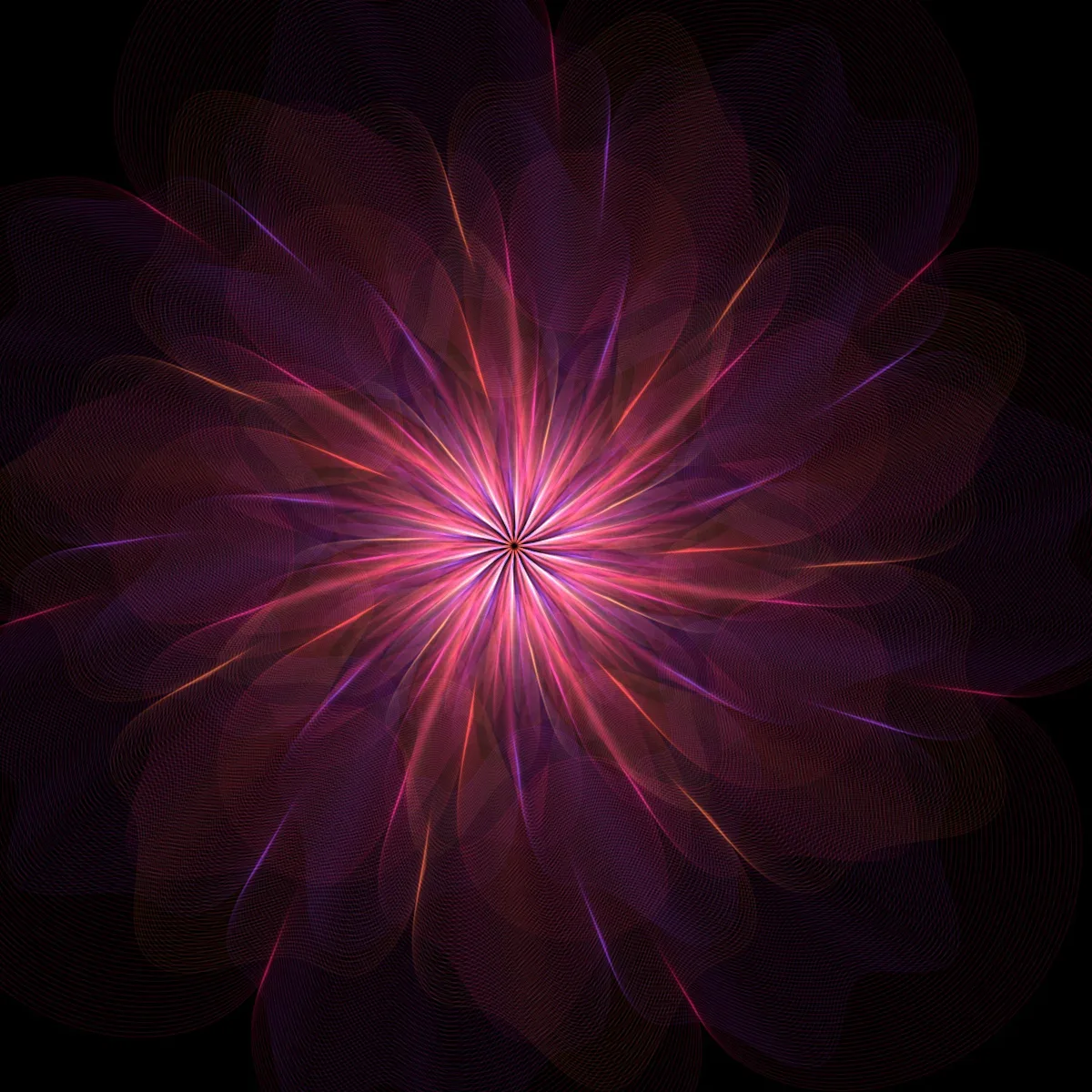
A rose-engine bloom on a black plate, in which nothing you can see is a line anybody drew. The unit of drawing is not a mark but a *pencil* — a family of eighty closed loops that differ only by a smooth sweep of one shape exponent — and every petal outline, every rib and every needle in the central star is a place where that family crowds. One profile makes all of it: a radius built as a waist plus a rise, the rise being sin(pi·u) raised to an exponent and multiplied by a bounded ripple, so a fat lobe, a lens and a needle are three values of one number rather than three shapes. The waist is what carries the picture: at zero a strand dives to the origin several times a turn and reads as a needle, and at three quarters it is a shallow undulation on a near-circle and reads as an arc running across — so as the waist ramps down the ladder the field turns from broad bands at the rim into converging needles at the centre, on one continuous construction rather than two kinds of mark. The picture is a geometric ladder of such pencils, each turned against the last by a fraction of its own petal cell, with the petal count halving inward — the outer layers carry `fold` petals and the inner ones twice that — and the ink walking the palette with a stride rather than in order, so colour steps crimson, gold, crimson, violet by layer while staying flat around any circle. The ink is light rather than paint: hairlines composite additively at an alpha normalised against the strand count, so the strand slider buys smoothness and never brightness and the plate cannot be burned white. With no swirl the pencil is provably nested and no two strands of a layer ever cross; swirl shears it into the crisscross that gathers at the tips, and is a pure shear that leaves every layer's radial envelope exactly where it was. Nothing is scattered, packed or rejected — the seed shapes the ladder and the rest is arithmetic, so the N-fold symmetry is exact to floating point rather than tuned.
- Medium
- Generative algorithm, archival pigment print
- Dimensions
- 90 × 90 cm