Imbricate
Lumen & Logic
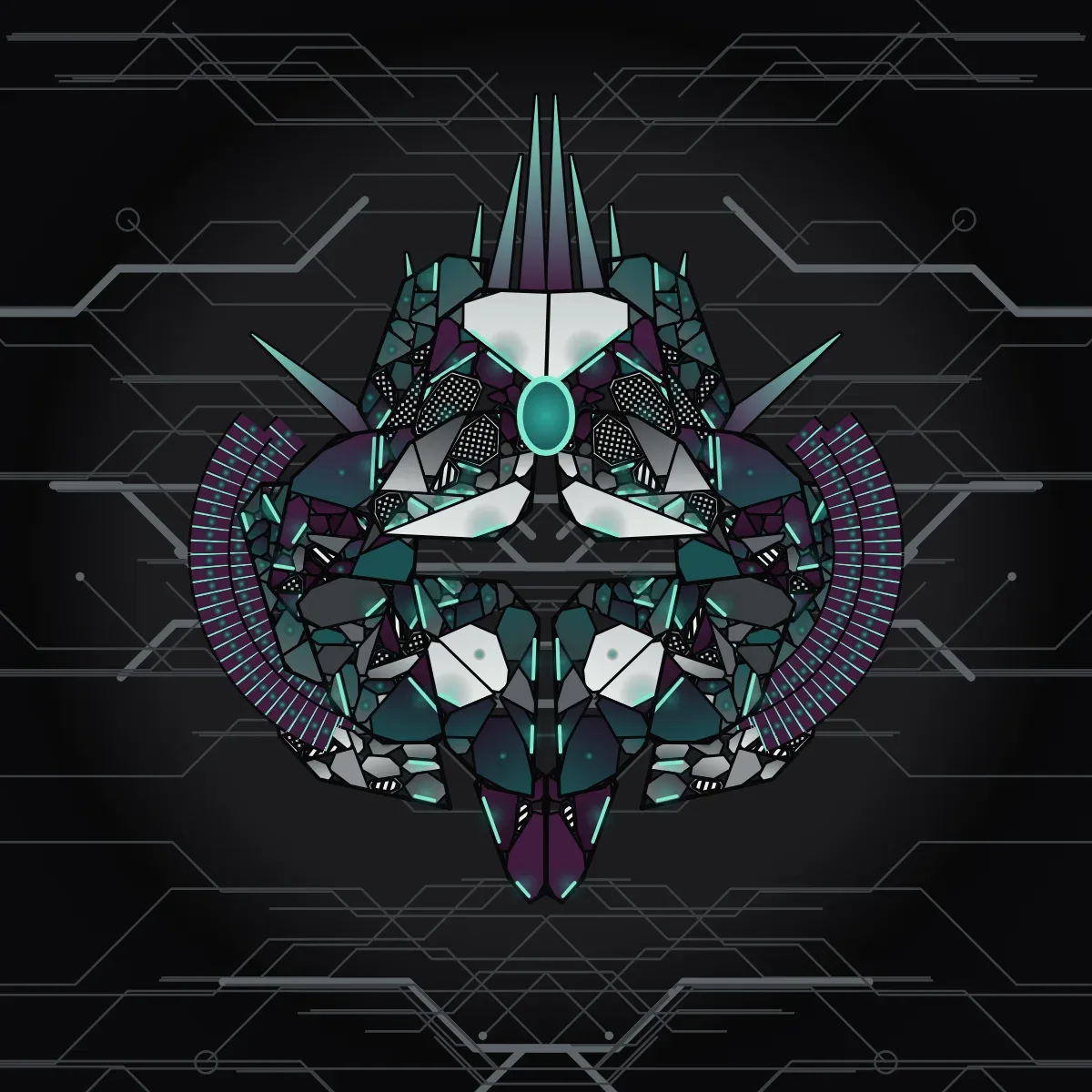
A frontal machine mask laid up out of two to four hundred overlapping plates on a near-black ground, in the manner the name says: imbricate, arranged in overlapping order like roof tiles, so what you see of any plate is what the next one did not cover. One armature of part boxes — a fan, a rake, a flank, a cheek, a jaw, and on the axis a crown, a brow, a muzzle and a chin — is laid out in a normalised figure frame; the right half and the centre are generated and the whole is reflected, and unlike its neighbour `brigandine` the reflection copies the paint as well as the geometry, so the two halves are the same picture and not merely the same silhouette. Each part hull is chamfered and then cut by one operator — a convex polygon split by a straight chord at a free angle — with any cut that would leave a sliver rejected and retried, and every plate chamfered afterwards, so the mask is blunt polygons and not shards. A plate is painted as a stack element rather than filled: a linear gradient along its part’s own axis, then at one plate in six a window inset into it holding a dot lattice or a run of parallel slats clipped hard by the window’s own outline, then a mint rail down its most axis-facing edge with a tight halo, then a glow, and last a black outline. That outline is the package’s second law: its width is set by the sheet and never by the plate carrying it, and the same is true of every texture pitch, which is what makes the picture read as drawn rather than modelled. Behind the mask a second generator obeys a geometry the mask does not share — a strictly octilinear field of grey traces, long horizontal runs joined by forty-five degree joggles and ending in ring pads and stub bars, mirrored about the same axis on a radial vignette that fades to black at the corners. Blades rise from behind the crown and segmented tubes hang from behind the flank, so neither shows where it begins. Nothing in the package knows what a face is: a mint ellipse on the axis over the largest silver plates simply reads as one, and a seed is free to produce a figure with nothing legible on it.
- Medium
- Generative algorithm, archival pigment print
- Dimensions
- 90 × 90 cm