Lariat
Lumen & Logic
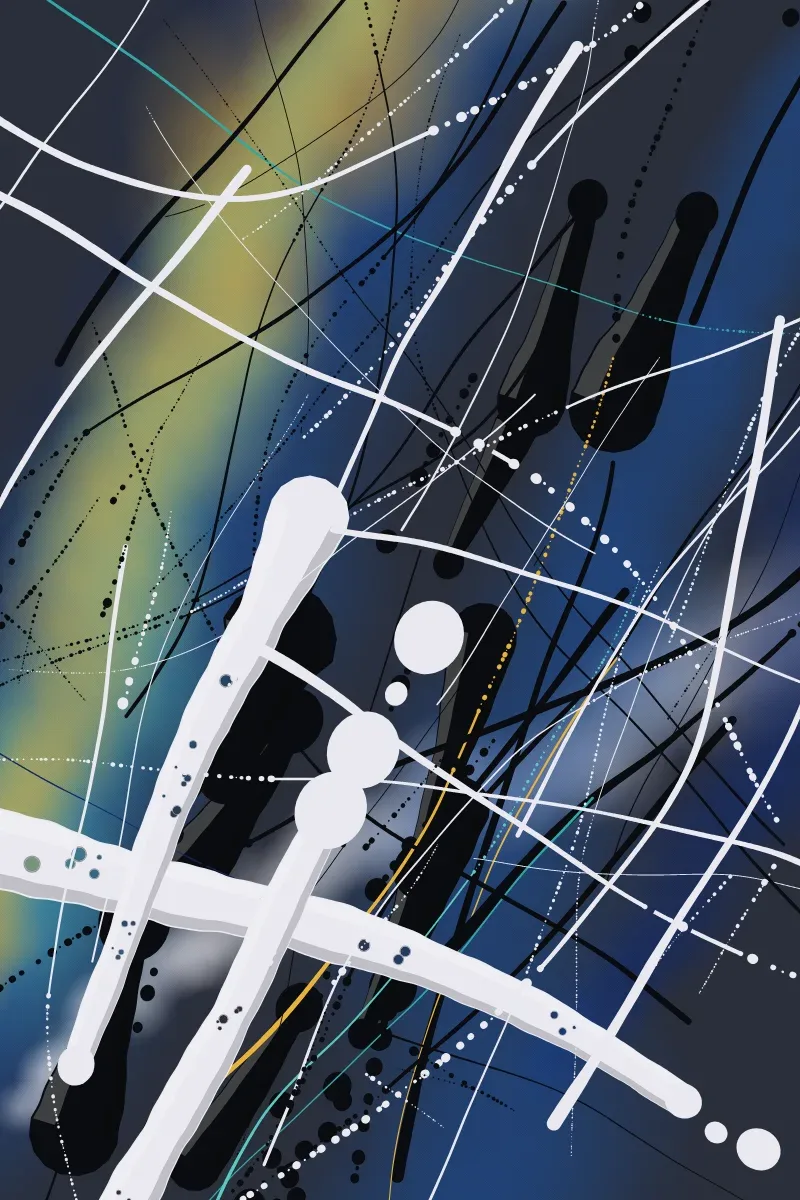
Paint thrown, not drawn. Every mark on the sheet is one filament of paint launched along a trajectory that keeps the curvature it left with — a heading walked by a mean-reverting momentum, so a mark sweeps, folds and occasionally closes a loop without ever being told where to end — while carrying a volume that decays as it is laid down, giving a width that starves monotonically from a blunt head to a needle tail. The whole element vocabulary follows from that one budget: loaded heavily and thrown slowly it is a broad opaque blade; loaded lightly it is a hairline whip; and once the radius falls under the paint’s own break threshold the mark stops being a ribbon and becomes a row of beads, their radius 1.89 times and their spacing 9.02 times the radius at which it failed, with a satellite drop in each gap — the classical Plateau–Rayleigh collapse of a liquid column too thin to stay a column, which is why the droplet fields read along the lines that spawned them and shrink as they go. Thrown fast enough the filament never forms at all and atomises instead, laying a soft cone of colour with no edge anywhere, and those sprayed cones are the only transparency in the picture. The thick marks alone earn the wet behaviours — pendant drips hanging straight down the sheet whatever direction the mark was travelling, a lit rail and a shadowed rail down their flanks under one consistent light, and round cells punched through to the colour beneath. Roles are taken from the palette by luminance, the darkest for the blades and the lightest for the pours, and everything is stacked in strict painter’s order over a shared diagonal axis, so no mark is ever glazed, blended or tinted by what it crosses.
- Medium
- Generative algorithm, archival pigment print
- Dimensions
- 60 × 90 cm