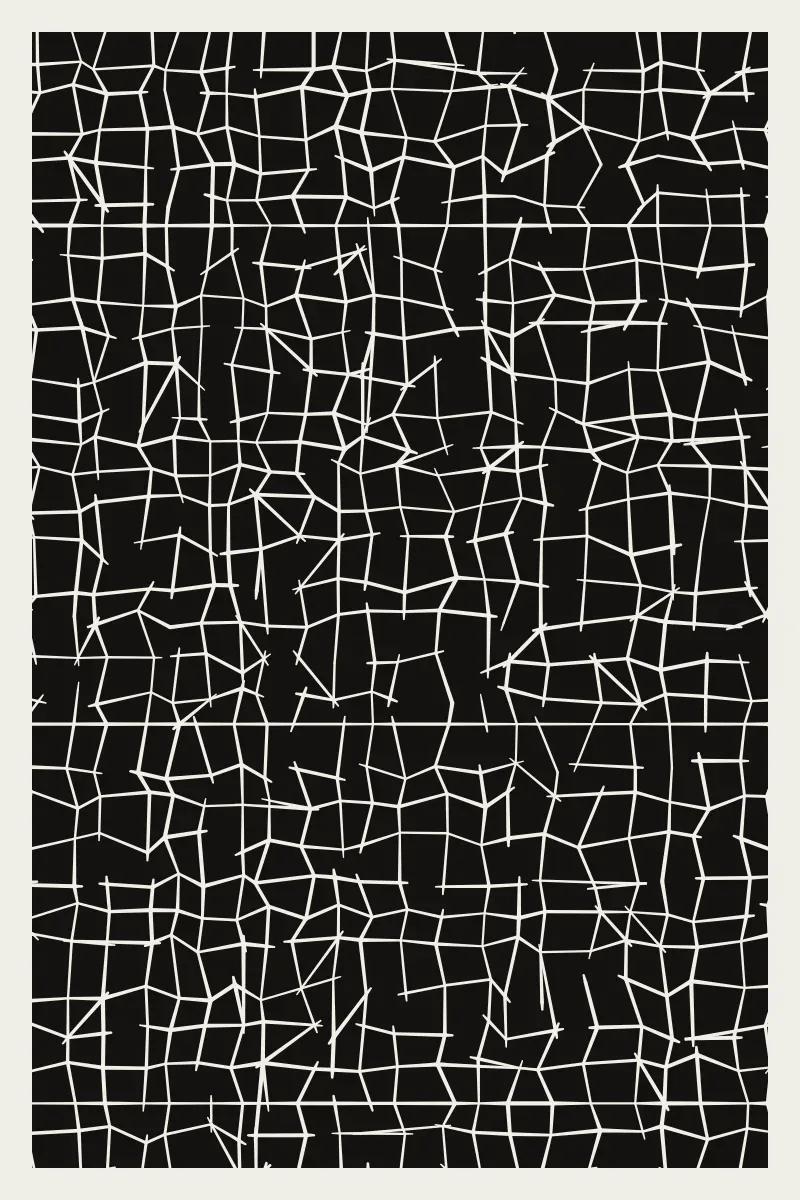
Lath
Lumen & Logic
A dense net of white laths on a dark plate: one rectangular lattice whose every node has been displaced once, drawn as the runs through those nodes rather than as lines laid over them. A run is a polyline whose vertices are consecutive lattice nodes, and every mark in the picture is one — the long jagged verticals, the broken horizontal stretches, the stubs that end in mid-air, the shallow diagonals that span two cells at a stride of two, and the short cell braces are five settings of one primitive, not five kinds of line. Because a node is displaced once and every run through it reads that one position, two runs that meet at a node meet exactly: every junction in the picture is a real joint rather than two lines happening to cross, which is what makes the field read as one grid under strain instead of a pile of independently wobbled strokes. Straightness belongs to the node as well: a minority of rows and columns are struck as battens, which pins one ordinate of every node on them, so a dead-straight rule crossing the whole plate is literally the run along that row — the jagged chains that cross it therefore have a vertex sitting on it, and where a batten row meets a batten column the node is the only one in the picture standing exactly on the undisplaced lattice. Weight belongs to the node too, so a junction is the same width for both runs through it and reads heavier than either. Displacement is capped at half the smaller of a node’s own two neighbouring gaps, so nodes can meet but can never swap order, at any setting and with no runtime check. Every mark is a fill and never a stroke — each segment a quadrilateral between its two nodes’ half-widths, each node a disc of its own radius — so the union is seamless at any bend angle with no mitre and no join, and a single opaque ink means paint order decides nothing about what is visible. The lattice overhangs the plate by a cell on every side and is clipped to it, so runs are cut by the frame rather than ending at it, and the package contains no edge case. Two inks and no third: no tone, no gradient, no transparency, no blend mode, no shadow, and no curve anywhere except the knuckle at a joint. Turn the jitter off and the same picture collapses to a plain ruled grid.
- Medium
- Generative algorithm, archival pigment print
- Dimensions
- 60 × 90 cm