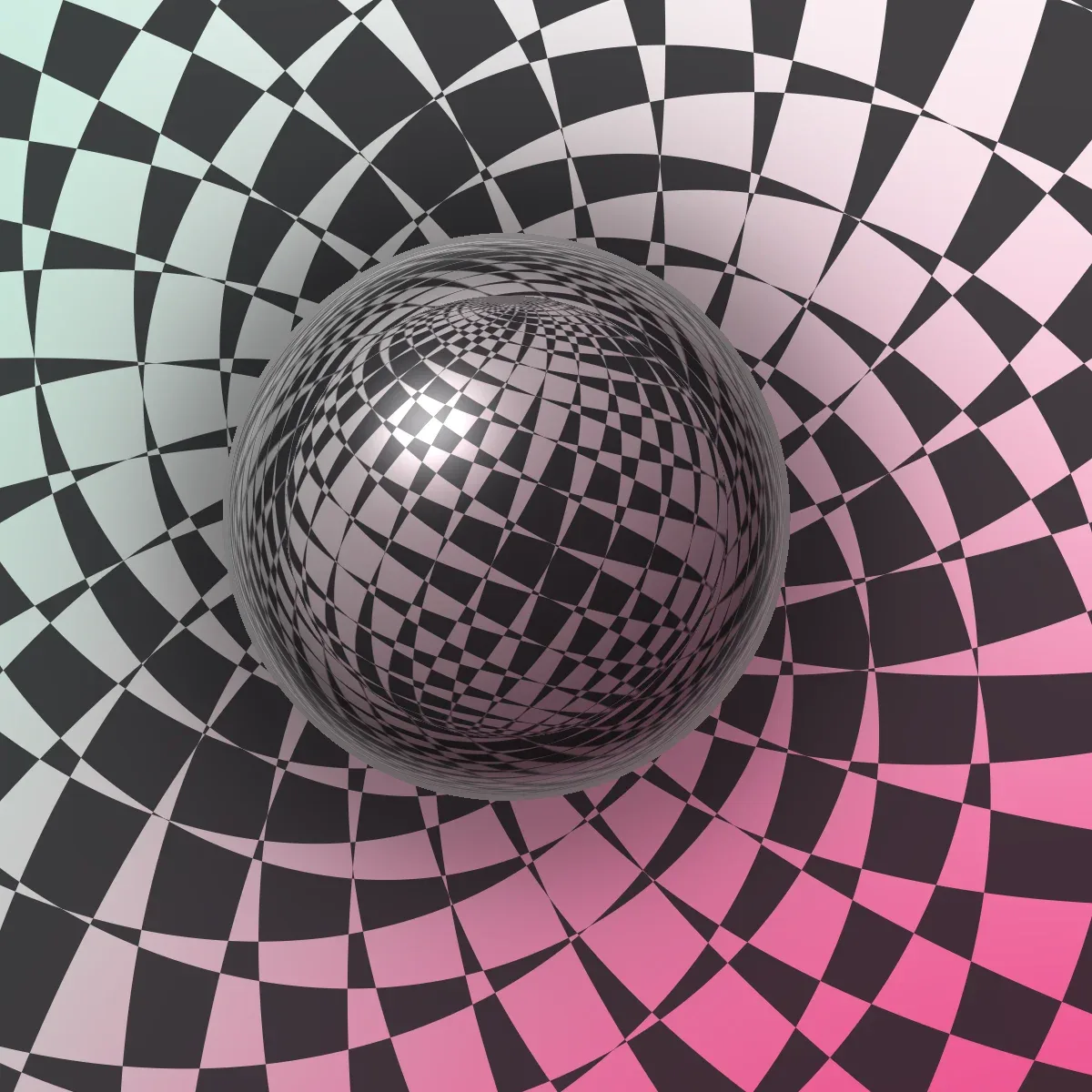
Loxodrome
Lumen & Logic
One checkerboard, drawn on a sphere and then shown twice. Take a plain unit checkerboard in Mercator coordinates — latitude stretched so the graticule stays square — and pull it back through the complex logarithm: the sphere's south pole opens into a bottomless throat at the middle of the sheet, its north pole flies off past the corners, and the cells become two orthogonal families of logarithmic spirals that cross at the same angle everywhere and shrink toward the throat by a constant ratio, so there is no innermost ring and never can be. Tilt the lattice and both families become loxodromes — the constant-bearing spiral a straight line in Mercator turns into on the way down — which is the only free choice in the whole map, alongside how many cells go round. Because the map is conformal it has a single isotropic scale at every point, and that is exactly what a box filter needs: each pixel is given the true average of the pattern over its own footprint in closed form, so where the cells fall below a pixel they do not sparkle or alias, they converge through a band of moiré rosettes into a clean flat grey. Sitting in the throat is the sphere the whole field is a shadow of, wearing the same checkerboard from the same two floor functions of the same two numbers, with the entire outside world squeezed and inverted into the shell of glass around it and running to infinite compression at its silhouette. Colour comes from a slow wash of three poles across the sheet: the light half of every cell takes the wash, the dark half stays near-neutral, and no cell is ever shaded, outlined or gradient-filled.
- Medium
- Generative algorithm, archival pigment print
- Dimensions
- 90 × 90 cm