Mullion
Lumen & Logic
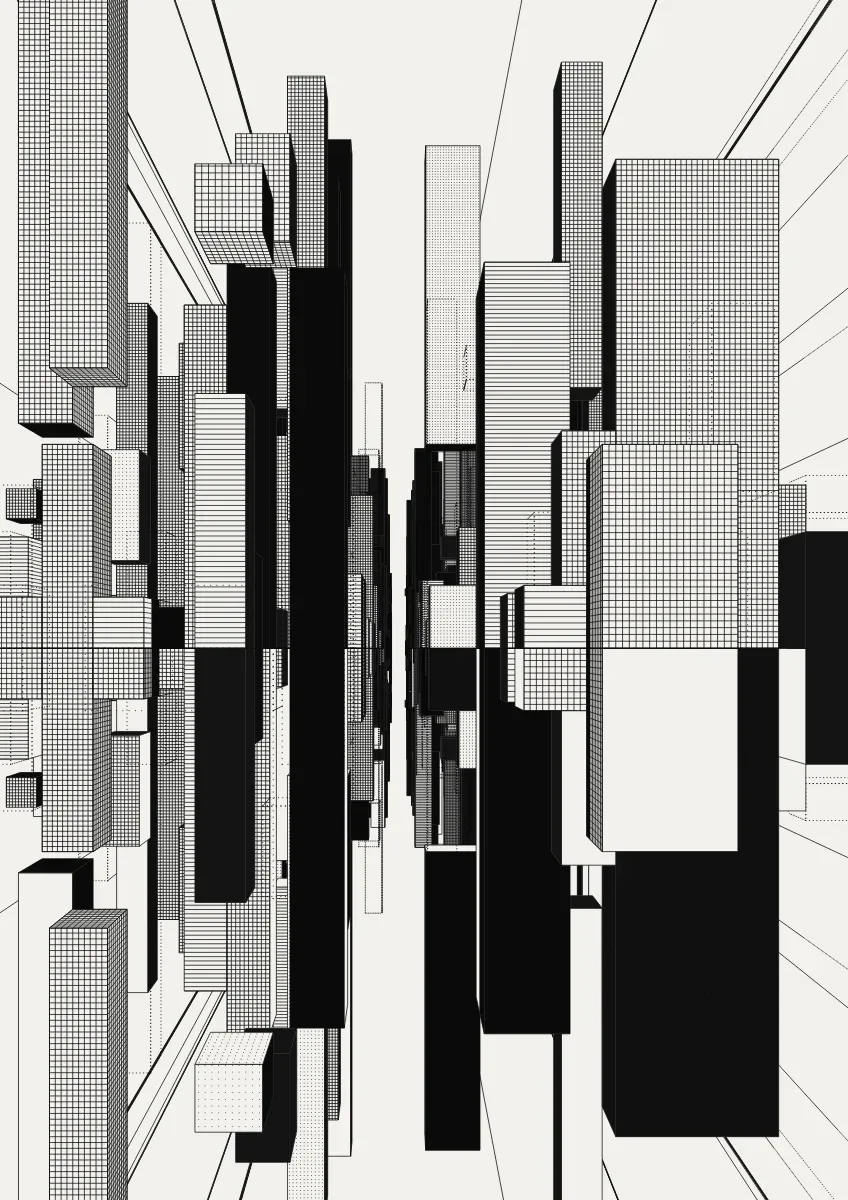
A flooded city seen down one street, and one lattice seen in perspective. There is a single world module — one plot wide, one storey tall — and every mark in the picture is either an edge of a box or a line of that module’s grid, so nothing anywhere carries a spacing chosen in pixels. Three things follow rather than being arranged. Every straight mark is horizontal, vertical or aimed at the vanishing point, because every mark is axis-parallel in the world and a pinhole camera has exactly one image for each axis. Tone is the projected pitch of that one grid and nothing else: the mullions close as the inverse square of depth while the courses close as its inverse, so a wall opens into a legible window grid near the camera, beats into moiré as the two rates part company, and finally passes the width of a hairline — at which point the lattice stops and the region is flat ink. The dark lens around the vanishing point is that locus, not a shape, and because a constant-pitch locus on a plane projects to a straight line, its edges are cuts parallel to each face’s own edges that nothing draws. Slabs are packed onto a lattice of plots either side of the street, a few lifted clear of the water so their soffits show, and they occlude by being painted back to front over their own paper. Unbuilt plots are drawn as dotted silhouettes, ticked at the same module, and long needles run past the built mass to the frame edge. The sheet is mirrored about the horizon because it must be: with the eye at water level the reflection of every point at every depth is the exact reflection of its image, so the symmetry is a measurement of the camera rather than a composition — and only the ink is re-rolled below the waterline, never the geometry.
- Medium
- Generative algorithm, archival pigment print
- Dimensions
- 64 × 90 cm