Oriel
Lumen & Logic
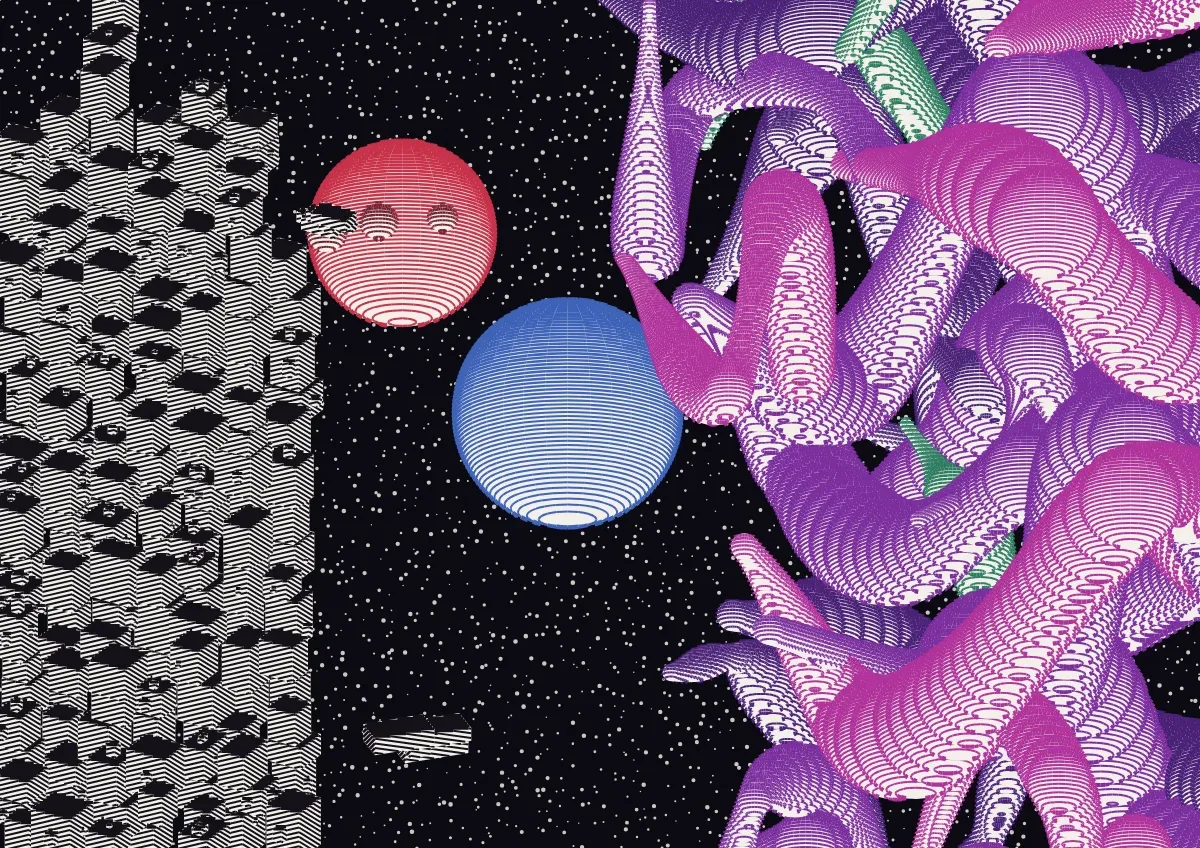
A pen drawing of a megastructure at one edge of the sheet, a star-filled void, a banded near body straddling it, and an enormous mass of hatched vapour filling the rest. There is one operation: a single stack of equally spaced parallel planes cuts every solid in the scene, and every stroke is a section of it drawn on whichever surface is nearest the camera. The latitudes of the planet, the shading of a cloud lobe, the laminar grain of the vapour, the nested eddies where it curls and the ruled panels of the megastructure are the same family of curves against differently oriented surfaces, and the tilt of that one stack takes a sphere from concentric ring shading to even banding. Nothing is shaded and nothing is filled to make a tone: the screen pitch of the sections is T/|∇Φ|, which collapses to zero wherever a surface turns edge-on, so limbs go inky, small bodies come out darker than large ones, faces angled away from the stack go solid and faces square to it open up — and the two limbs of a body close at different rates, which is a terminator with no light source anywhere in the algorithm. Because the phase belongs to space rather than to bodies, the level sets run unbroken across a union of overlapping spheres, which is what makes a chain of balls read as one body of vapour with a continuous grain instead of a heap of separately hatched lobes. A sphere section projects to an exact ellipse and its visible arc is a closed-form interval, so a stroke is one canvas primitive and no geometry is ever sampled; a thumbnail and a full-size export are the same curves. Space is the ground and every solid fills its own silhouette with paper before it is ruled, so the void is where no solid happened to be and the stars survive only in the gaps.
- Medium
- Generative algorithm, archival pigment print
- Dimensions
- 90 × 64 cm