Ovolo
Lumen & Logic
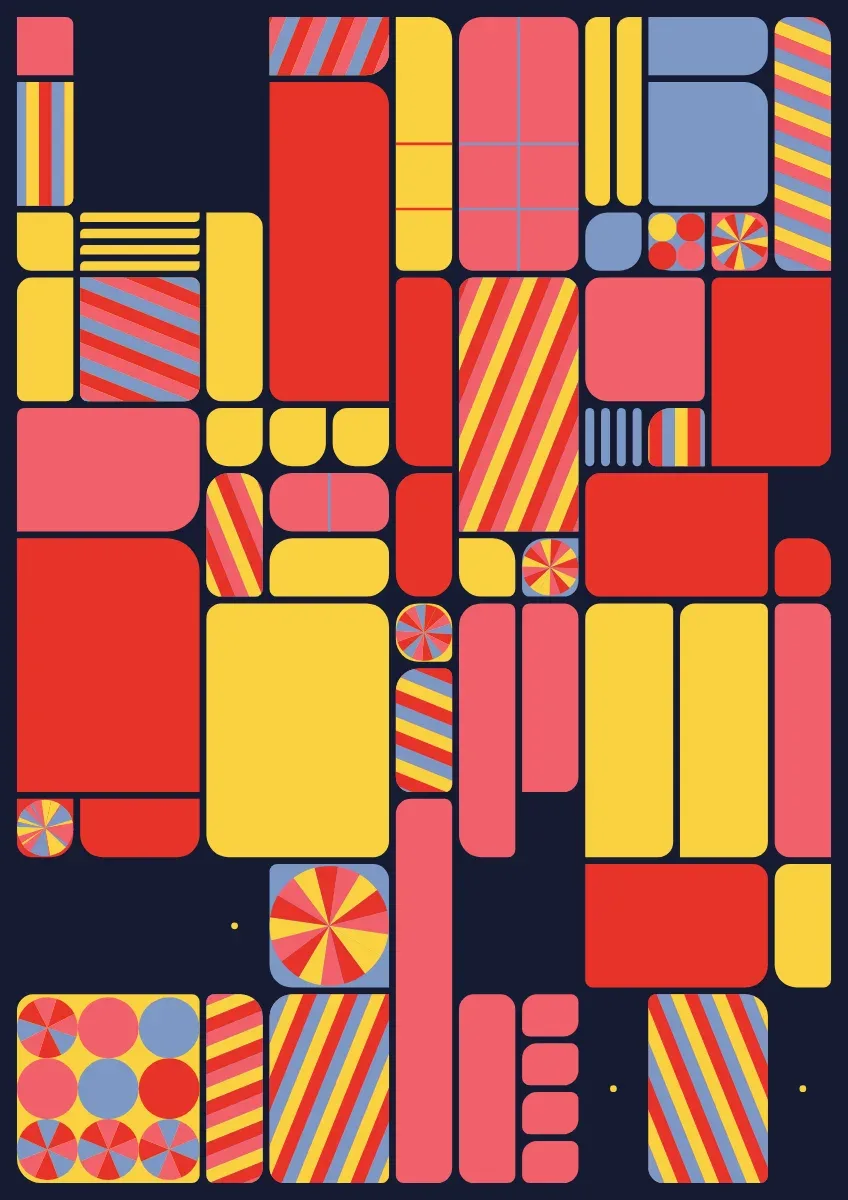
A sheet of ink cut into flat-colour panels by two rulers, where every panel is the same shape and every corner radius belongs to the grid rather than to the panel. One module is read off the short edge and the field is divided into an integer number of units by it, so every cut in the picture lands on one lattice and the column and row counts are outputs rather than settings; the cells are then claimed by one greedy scan that always takes the maximal free rectangle, so the panels are an exact partition and a panel can run down three rows without any packing having to succeed. There is one primitive: a rectangle with four independently struck corner radii, drawn as four circular arcs and four lines. A square panel at full radius is a circle, a long one is a pill, one rounded on a single side is an arch — so the arches, pills, discs and stadiums in the picture are not four shapes but four settings of one, and there is no curve anywhere in the package that is not a circular arc. Each lattice node is dealt one radius, clamped to what the smallest panel cornering on it can afford, and every corner landing on that node is struck on exactly it: neighbours agree by identity rather than by two computations matching, four generous panels open the channel between them into a symmetric four-lobed pool, and one sliver squares off its whole neighbourhood. The channel itself is never drawn — the ground is painted once in the ink colour and every panel is inset by half a gutter on each side, so the gap between any two panels is exactly one gutter wide whatever their sizes, and the sheet's border is a multiple of the same figure. The ink is a colour and not a background: a share of panels are dealt it and vanish into the sheet, known only by the small disc a few of them carry. A panel's field is one flat hue and whatever it carries walks the remaining hues in ring order starting one past its own, so no mark can ever repeat its panel’s colour however many wedges, bands or discs it runs to — which is why nothing in the picture needs an outline. A minority of panels are dressed, each strictly inside its own edges: a cross of thin rules on the panel's own interior unit lines; a group of bars lying a gutter apart in the panel’s own colour, with the ground showing between them and the parent’s rounding kept on the side they sit on; a wheel cut into equal sectors, sometimes overprinted by a second wheel of a different count so the rim breaks into lenses; a square array of tangent discs leaving the field showing in the cusps, some of those discs being wheels themselves; a field of thin bands at the sheet’s one ruling pitch, phased from the sheet’s own origin so bands stay in register across a channel and a large panel simply carries more of them; and a thick band that turns a single corner through a quarter annulus and runs off two edges. Nothing overlaps, nothing is occluded and nothing crosses a channel, so paint order decides nothing about what is visible. Flat opaque colour throughout: no outline, no gradient, no transparency, no blend mode, no shadow and no texture.
- Medium
- Generative algorithm, archival pigment print
- Dimensions
- 64 × 90 cm