Quadrat
Lumen & Logic
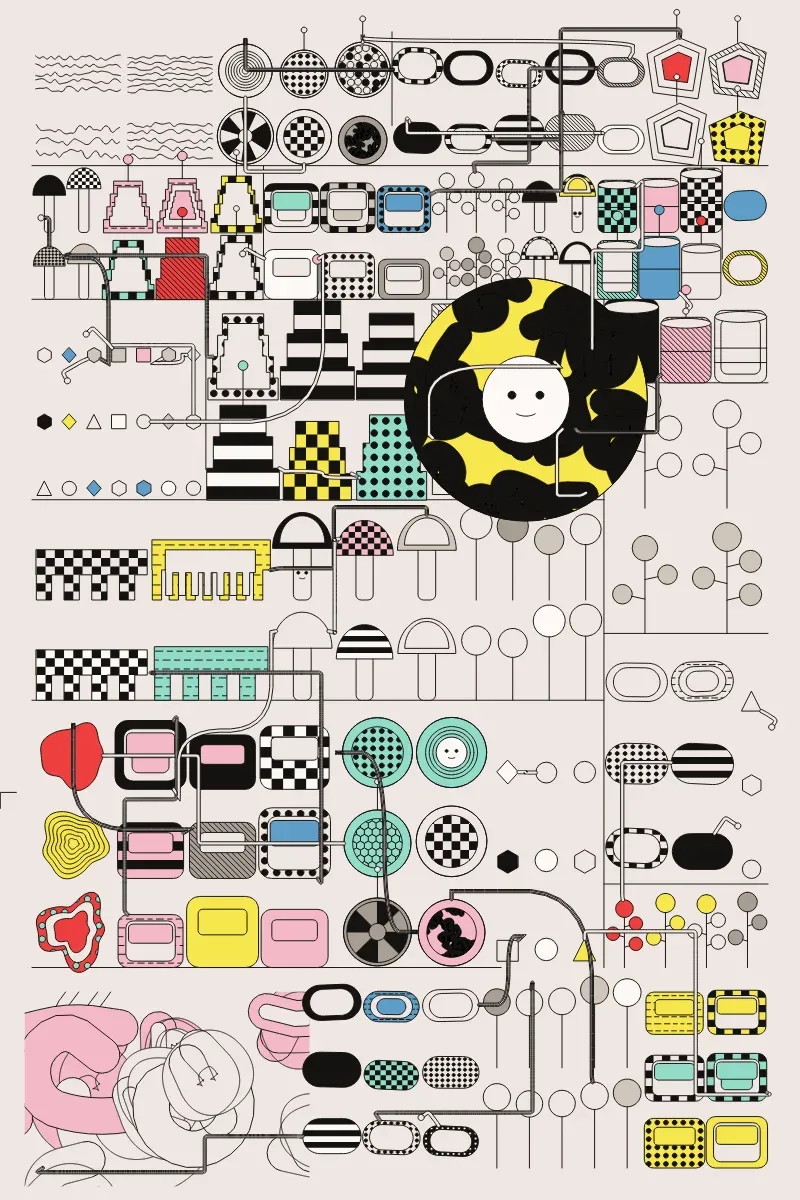
A specimen plate justified like a page of type. The sheet is cut by bare hairlines into a stack of shelves whose heights are whole multiples of one small unit, and each shelf is filled left to right out of **runs** — one skeleton repeated several times over, each instance dressed differently — until the runs exactly tile the shelf, either by being stretched to butt against one another or by leaving a blank quad for the page’s furniture to occupy. A run is not a scatter of similar things: along its length exactly one property advances and the rest are drawn freely, so a rank of half-dome creatures steps from open paper through stripes and checks to solid, a rank of spools steps up the tone ladder, and a block of swatches darkens across the page — which is what makes a row read as a series rather than as a crowd. Twenty-one skeletons share one grammar — half-domes on stub legs under antenna stems, fluted spools, nested capsules, bent tubes, stepped ziggurats, combs, kites, solid bars, swatch blocks, lens eyes, tiny chits, asemic scrawl, braided tangles of nested noodle packed until they nestle, medallion circles opening onto pebble packs and radial pie wheels, contoured amoebas, capped stalks and flooded colour panels — and it is the grammar rather than the cast that holds the sheet together: every closed form carries an outline of one single weight and colour, and every form is opaque, so an unfilled form is filled with the paper rather than left clear and depth is occlusion alone — no shadow, no gradient, no transparency anywhere. Hero bands stand a column of specimens against a block edge across several shelves, one hero form is drawn large enough to spill past its own rules and is then deliberately overrun by the ranks beside it, and a graph of wires — tubes, not strokes, so they occlude what they cross — leaves a named point on one specimen, turns through filleted elbows, and arrives at a named point on another, tying the ranks back together across the rules. Colour is clumped rather than sprinkled: a whole run draws its heat at once, so passages of the plate go near-monochrome and passages go hot, and the sheet stays four fifths bare paper with a single accent carrying real area. Ghost type, caption rules, corner ticks and dot rows are tucked into whatever paper the occupancy grid still calls free, and one form carries a blank face of two dots and a small arc — the plate’s only figurative note, and its only concession to a subject.
- Medium
- Generative algorithm, archival pigment print
- Dimensions
- 60 × 90 cm