Ravel
Lumen & Logic
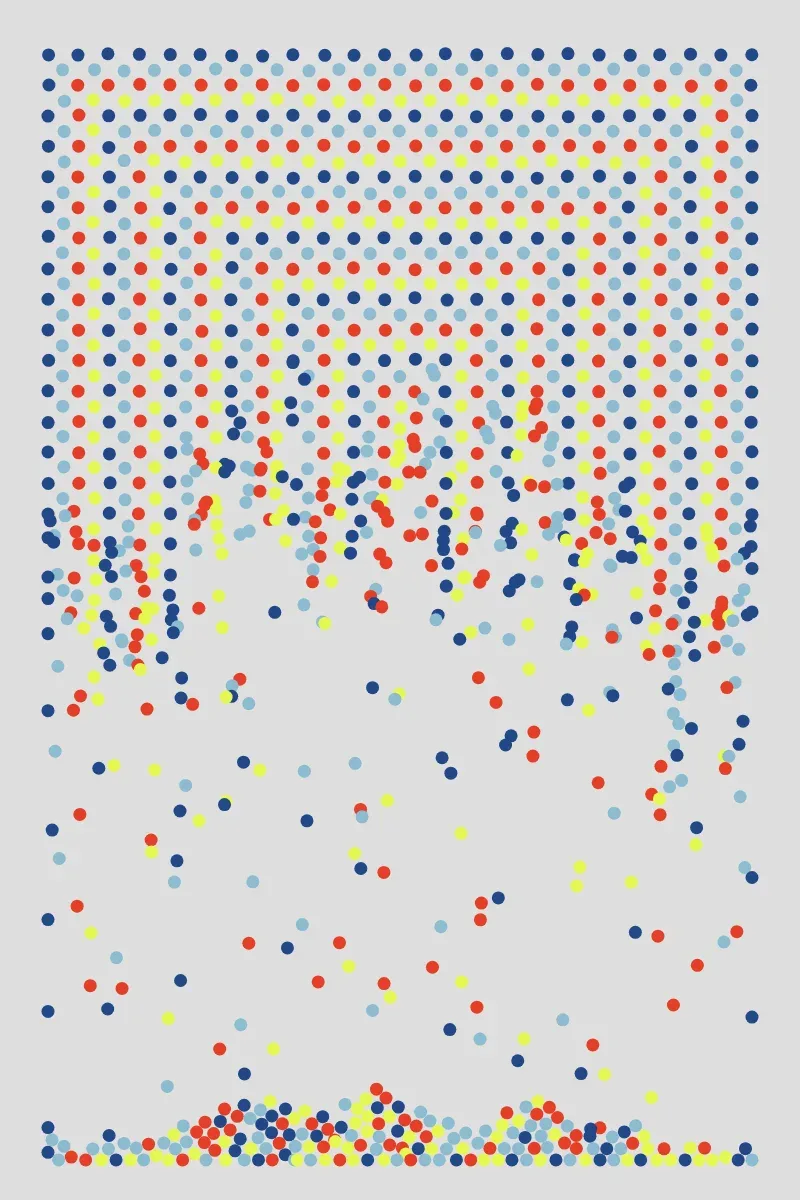
A rigid checkerboard of identical discs that holds across the top of the sheet, loses its grip along a ragged front, compacts, falls, and settles into a granular bed on the floor. The lattice is a checkerboard and not a square grid — only the sites where row and column indices sum to an even number carry a disc, so the nearest neighbours sit at a diagonal and the rows alternate between one more and one fewer. Colour is arithmetic rather than chance: a disc is dark if its row index is even and light if it is odd, and it is warm if the Chebyshev distance from its site to the sheet’s top and side edges, counted in double cells, is odd — which is a stack of nested rectangular frames opening downward, read as interlocking chevrons at the top and, past the point where the frames would close, as plain vertical stripes. A disc keeps the colour of the site it came from wherever it is finally drawn. An erosion front, deeper at the sheet’s two side edges than in its middle and rough from column to column, divides the sites that still hold from those that have let go; released material first compacts toward the front, which is why the band immediately under it is denser than the lattice that fed it, then falls, each row further along than the one above, with an exponent steep enough that most of it is still bunched under the front and only the earliest releases have reached the floor. What reaches the floor is deposited by rolling into place, which is what gives the bed its bumpy, single-disc-scale surface. Every site emits exactly one disc: nothing is created, nothing is destroyed, and the only thing that varies across the sheet is how far along its fall each disc has got.
- Medium
- Generative algorithm, archival pigment print
- Dimensions
- 60 × 90 cm