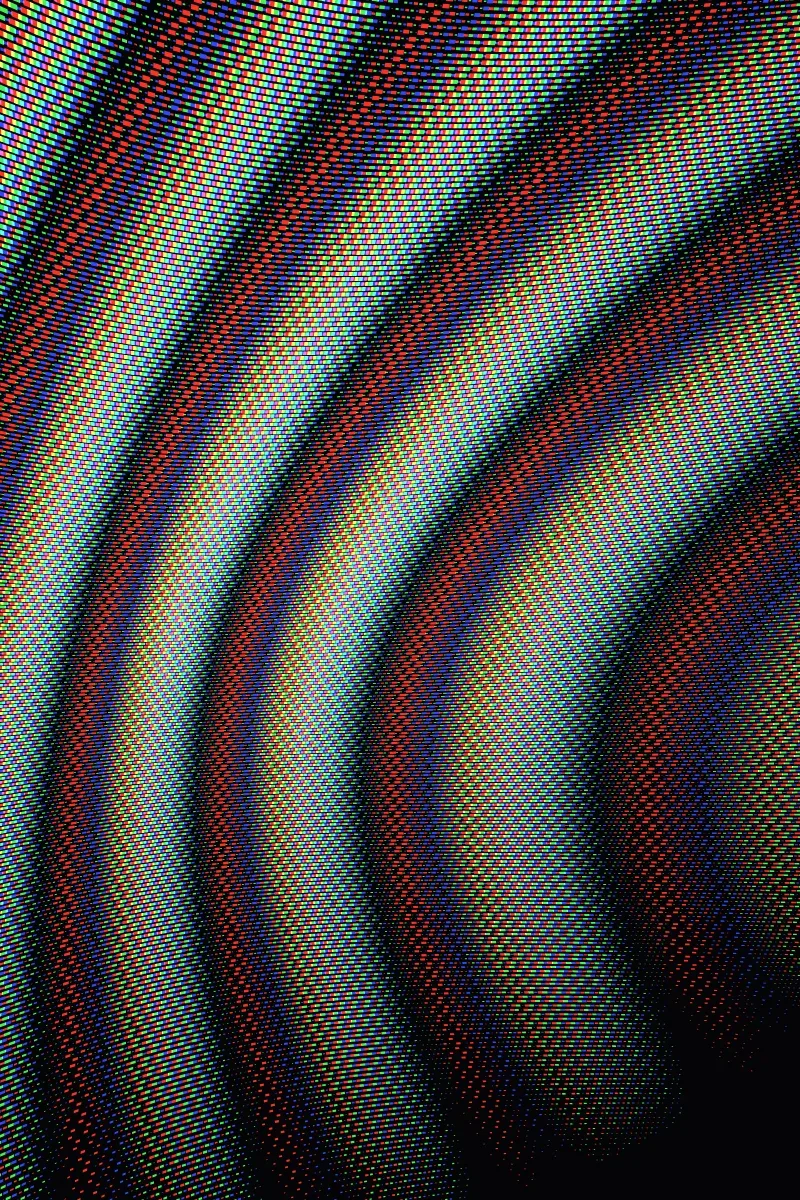
Réseau
Lumen & Logic
One regular lattice built on a flat surface, bent once, and lit. A single smooth map carries a rectangular grid from that surface to the canvas — a perspective divide that compresses it to one side, then a radial term about a movable centre that bends its straight rows into arcs — and every curve in the finished picture is that one map, so the rows, the colour bands and the lean of every mark cannot disagree. Each cell carries exactly one of three phosphors on a fixed three-cycle with a row-to-row shift, and fires only as hard as that phosphor is wanted where it stands. Three of the picture’s most characteristic features follow from that and nothing draws any of them. Where the light wanted is a pure primary, two cells in every three go dark and the survivors form a sublattice of index three — three times the area per mark, and its texture turned through a right angle to run diagonally, so saturated regions come out visibly coarser than pale ones. Where the light is strong, marks swell past their own cells and fuse, and the only thing left of the ground is a lattice of holes at the cell corners; the bloom is capped as a fraction of each mark shape's own sealing scale, so those holes can never quite close, at any setting, with no runtime check anywhere. And the field is sampled once per cell rather than per pixel — as a mask cannot show detail finer than itself — so its frequency beats against the lattice's and throws fringes far broader than either. A mark's colour is the pure phosphor and never varies; the drive is carried by size alone, at an exponent of one half, which makes the ink's share of the surface exactly proportional to the drive and independent of where the warp has compressed the lattice. Five mark shapes — dash, dot, slot, lozenge, chevron — each a polygon in its cell’s own sheared frame. Flat and opaque throughout: three inks on a ground, no outline, no gradient, no transparency, no blend mode and no blur. The additive colour is spatial, done by the eye, which is why the highlights are a fine speckle rather than a smooth white.
- Medium
- Generative algorithm, archival pigment print
- Dimensions
- 60 × 90 cm