Sley
Lumen & Logic
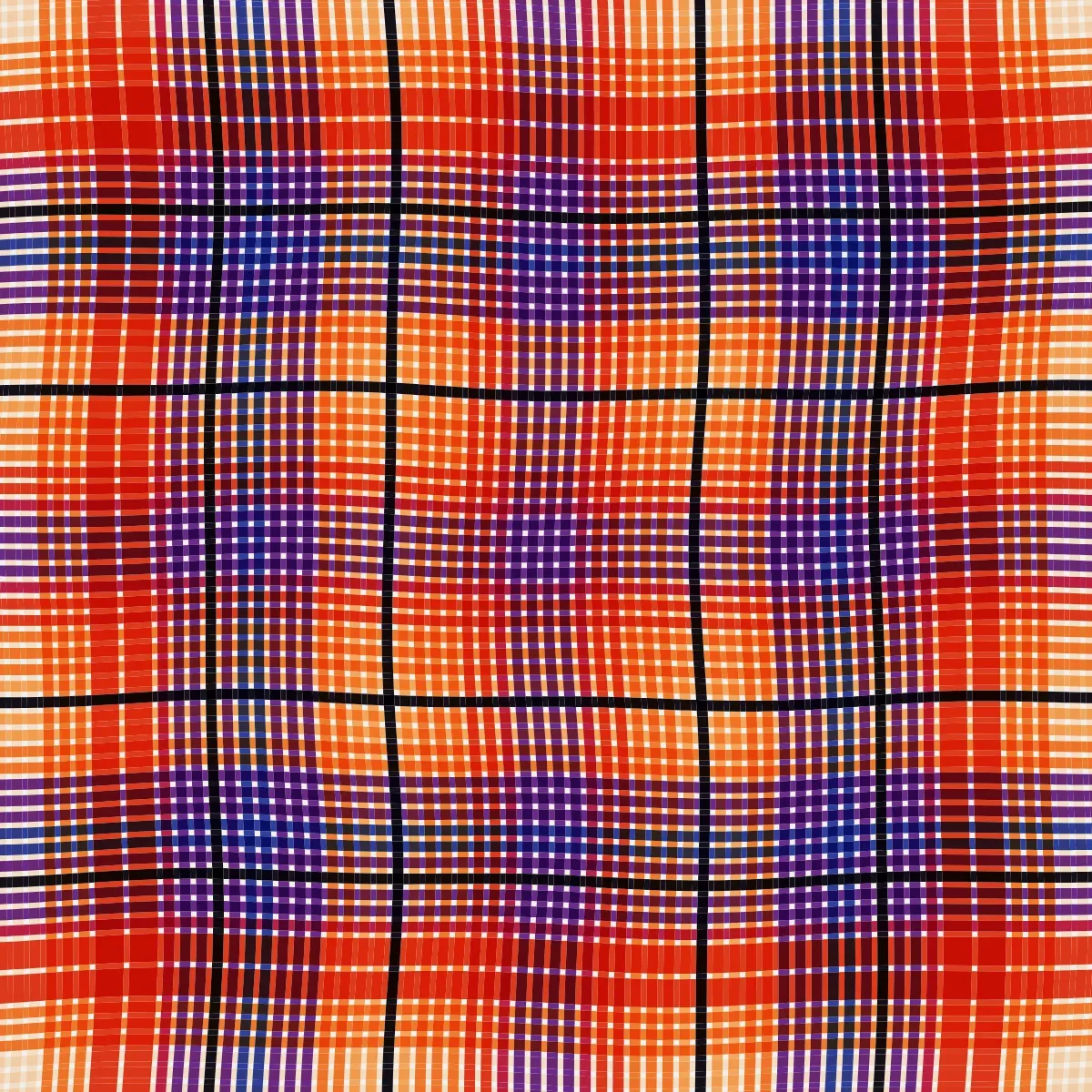
A cloth filling the frame edge to edge, sixty-odd vertical threads crossed by sixty-odd horizontal ones, with a small bright hole of bare paper wherever two of them miss. Nothing in it is in front of anything else: a crossing is not the colour of whichever thread won but the per-channel product of what both of them let through, so it is always darker than either thread and than the paper, and no thread is ever occluded, shadowed or outlined. The picture is therefore the outer product of two one-dimensional sequences and nothing more — it is rank-1 in optical density, so the discrete mixed second difference across any four crossings is exactly zero, and every two-dimensional thing the cloth appears to have is that identity at work rather than a field anyone painted. The consequence is that most of the hues in the finished picture are absent from its own palette: the broad red passages are orange crossing orange, the near-blacks are a warm thread crossing a cold one, and the palest are two washed bands meeting. Each sequence — a sett — is a run-length walk that steps one place at a time along the palette read as an ordered ramp and reflects at either end, so colour arrives in bands of several threads and the cloth reads as a tonal excursion out and back rather than a cycle or a wander; bands are punctuated by washes diluted toward the paper and by slubs of up to two and a half times the common width, and a few guard rules in an ink that belongs to no band cross the whole sheet at a coarse even spacing. The sett is reflected about the centre of the cloth, and the weft may repeat the warp, so the picture can be symmetric in one axis, both, or across its own diagonal. The gap between threads is one absolute width taken from the mean pitch rather than a share of each thread, which is why every hole is the same size while the bars are not. One shared smooth map sags the whole cloth by about a thread's width, coherently, so neighbours bend together and the weave is slightly out of true without any thread wobbling on its own. The multiply is arithmetic rather than a canvas blend mode, so the ink is computed against the background’s primary colour and a thread has one colour along its whole length whatever is drawn behind the holes; every fill is opaque, every length is a fraction of the frame, and a thumbnail and a full-size export are the same cloth.
- Medium
- Generative algorithm, archival pigment print
- Dimensions
- 90 × 90 cm