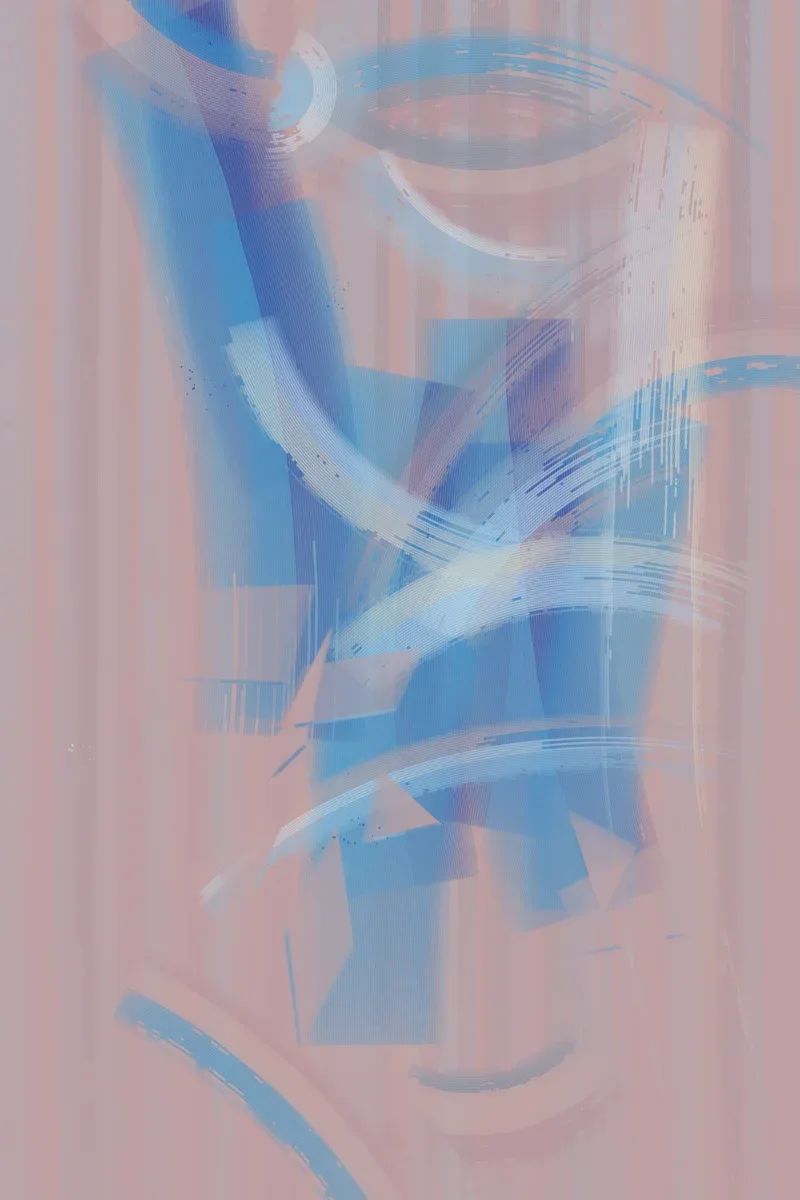
Squall Glass
Lumen & Logic
A cold blue gestural squall standing in a column on a dusty blush ground, built by simulating one tool rather than by drawing marks. The primitive is a wide flat blade whose width is divided into cells, each carrying its own pigment, its own remaining load and its own bristle height; dragging it along a path steps that array across a wet pigment buffer, and each cell both deposits a fraction of its load and mixes the colour underneath it back into its own charge. Because the charge is fixed across the blade, a sweep keeps the same striation order from head to tail; because it depletes, every sweep starts opaque and ends in broken dry grooves; and because the blade picks up, the tail of a stroke is coloured by whatever it was dragged across. The same tool set flat and pushed a short distance takes paint away instead — the swept pose of a straight edge is a straight-edged convex plane, its interior smeared along the push, its far edge beaded with the pigment that rolled up in front of it, so the translucent facets are scraped rather than drawn and vanish where there was no paint to remove. Flicked, the same blade atomises: a wide cone of thousands of faint droplets is a soft cream bloom, a narrow cone of a few heavy ones is spatter. Vertical drags lay the blush and slate ground first, dark cobalt masses go down next, arcs sweep over them, planes are scraped back into them, and the blooms and spatter finish. Nothing is outlined, nothing is filled, and no colour is sampled from the palette twice — after the first stroke, the paint is whatever the blade has been through.
- Medium
- Generative algorithm, archival pigment print
- Dimensions
- 60 × 90 cm