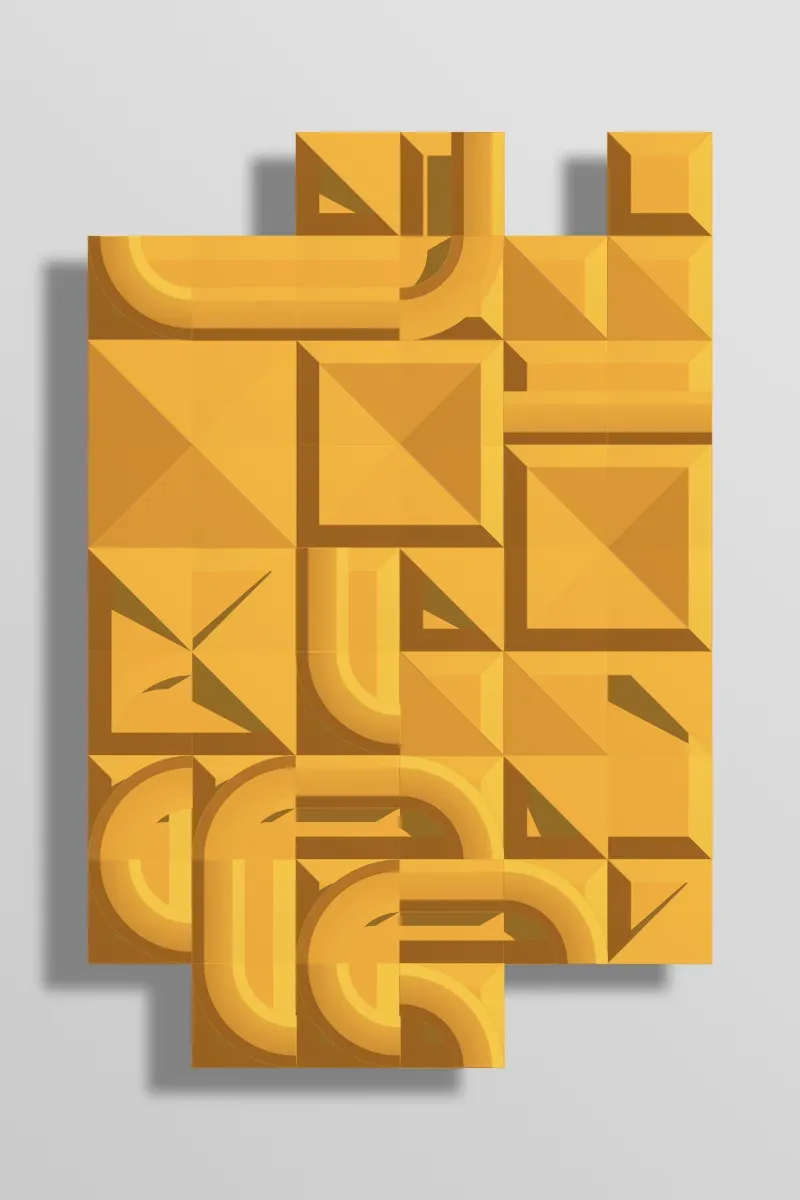
Squinch
Lumen & Logic
A relief of one paper, seen square on, in which every tone is an angle. There is a single hue and a single light, and the whole range of the picture — the pale faces, the amber ones, the near-black soffits — is one sheet turned five ways, so nothing in it is coloured and everything in it is lit. The unit is a square cell and every event happens at a corner of one: a corner folded up into a tent or down into a pit, swept round into a quarter-arc of radius exactly one cell, run past by a straight band of the same width, lifted into a flap with a soffit hanging under it, or sunk into a scoop cut through to the wall. Seven motifs, four rotations, and no free placement anywhere. The large forms are not large tiles but agreements between neighbours: a hipped pyramid is four cells that have settled on one lattice corner, and a ribbon is a run of cells that have matched ports edge to edge, so what reads as a composed object is emergent from a grid. One chamfer law does most of the drawing — every step in height, straight or curved, takes the same bevel, and because a bevel is toned by its own normal the same rule lays the bright band along every up-light edge and the dark one along every edge facing away, including the crescents on the arcs. Shadow is a mark rather than an effect: a flap darkens its own soffit, a band darkens the sheet beside it, and the panel darkens the wall behind it, all from the one light vector that shades the faces. Because a shadow can only fall on something lower than its caster, sorting the facets by height is the entire depth solution — there is no camera, no perspective and no z-buffer.
- Medium
- Generative algorithm, archival pigment print
- Dimensions
- 60 × 90 cm