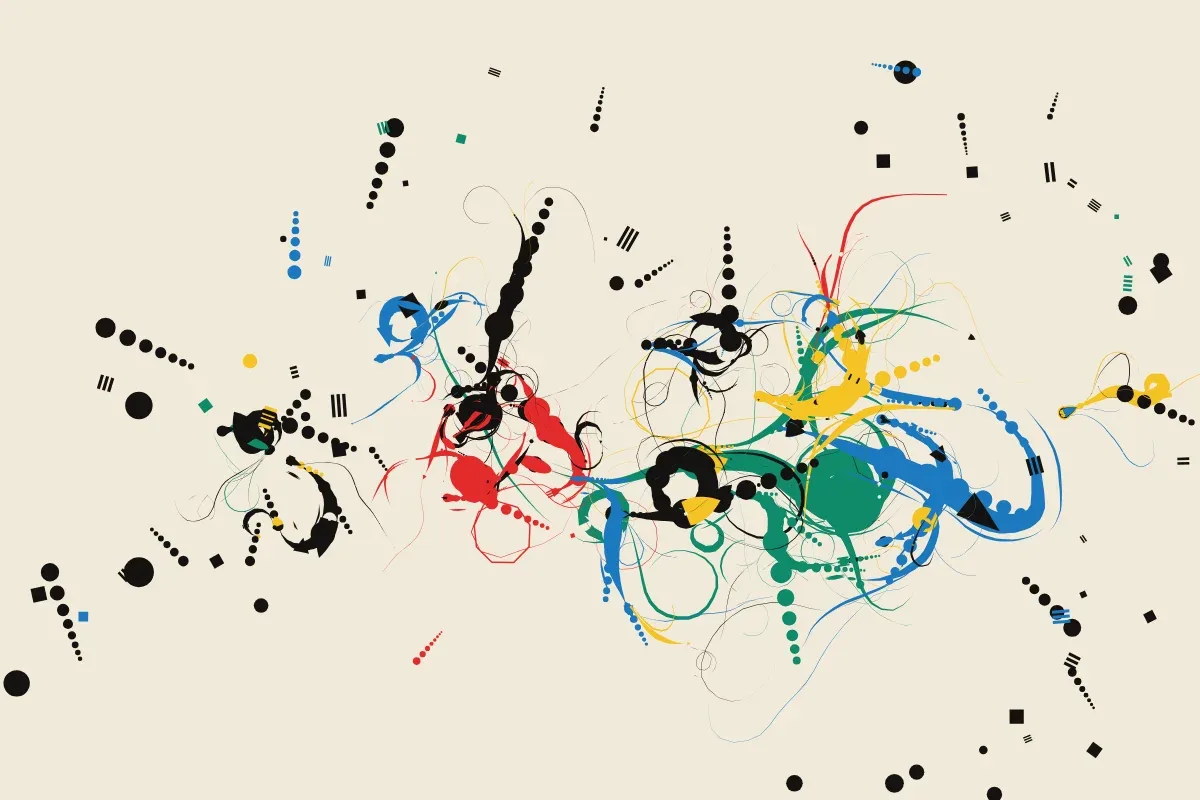
Swash Swarm
Lumen & Logic
An exploded piece of calligraphy floating on bare paper. A lens-shaped envelope is laid over an undulating baseline, and a handful of primary strands are walked through it by curvature momentum — a share of them dropping into a loop phase that curls the strand back through itself — then swept into flat polygons by a width profile that swells at the belly and runs to a true needle point at the ends, so every large mark reads as a brush swash rather than a band. A recursive attachment pass hangs satellites off sampled sites along those spines, each one inheriting the local tangent so it reads as growing out of its host: solid discs and rotated ellipses, bowed cones tapering to a spike, bead trains of shrinking dots running off a terminal, pointed lenses, squared-off comb bars, tiny chips, hairline whips that peel away and curl into the margin, and thin echo lines shadowing a big curve at an offset. The largest forms carry counters painted back in the ground colour — ring holes, crescent bites, chip punches — so a disc becomes a donut and a heavy form becomes a shell. Colour is drawn from a slow spatial zone field so each ink clusters in one region without any zone becoming pure, with children usually inheriting their host, and a share of marks taking the structural ink instead. Everything is opaque and painted largest-first with a weave jitter, so depth is occlusion alone and the stack interleaves rather than sorting cleanly. The swarm lays out as a horizontal lens, a radial bloom, a vertical column or a one-sided comet, and whatever bare ground is left just outside it is dusted with tiny chips, ticks and beads. Fill adds primary strands on top of the strand count — more of the biggest shapes, not just more dust — while also raising the ceiling on satellites and micro-marks and spreading strand start points across the whole envelope rather than clustering them at its centre, so the same swarm can read as a spare gesture or, at full fill, as an edge-to-edge field. Flat fills only — no outlines, no gradients, no shadows, no transparency and no text anywhere.
- Medium
- Generative algorithm, archival pigment print
- Dimensions
- 90 × 60 cm