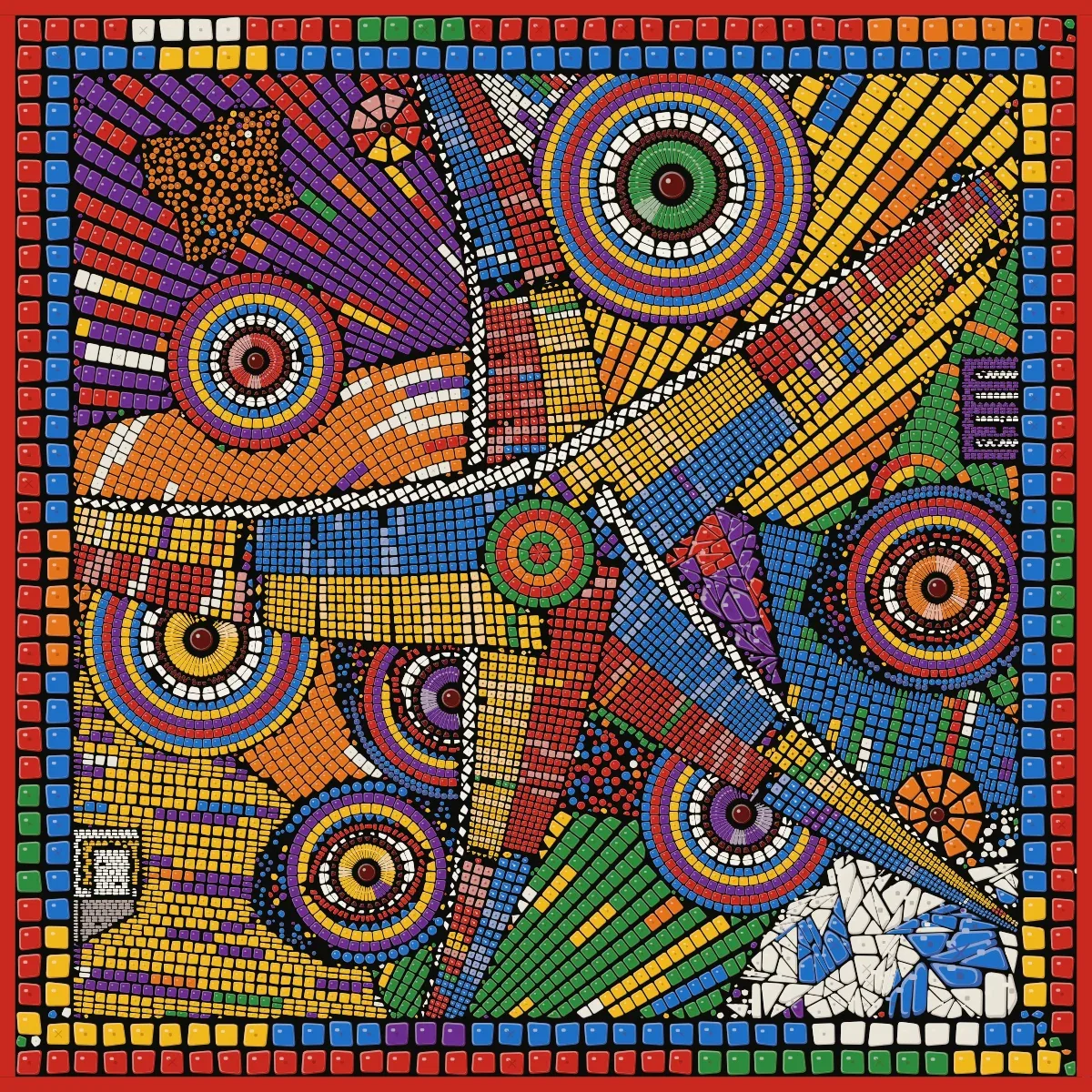
Tesserae
Lumen & Logic
A glass-mosaic panel in which every mark on the plate is a tile. The ground is flooded black once and every tessera is then set into it inset from its own cell, so the black between the tiles is exposed grout rather than a drawn outline, and each tile carries a flat opaque fill, eased corners, a two-shade bevel lit from one direction shared by the whole plate, a small gloss and a faint incised mark. Nothing overlaps: the picture is a planar partition of tile fields, so a form does not sit over the background but replaces it, and depth comes from the bevel alone. What makes it read as mosaic rather than as mesh is the andamento — courses run parallel to the boundaries they meet, wrapping every medallion in concentric bands before relaxing back into the drift of the field, running as brickwork with a running-bond offset inside the long forms, converging as a false-perspective lattice down a tapering blade, nestling as dart-thrown pebble beds across the open ground, and breaking into rings, radial fans or crazy paving where a field needs to read as turned or shattered — with every tile graded smaller as it approaches a boundary so a course can turn a tight corner without tearing. A radiant subject of tapering blades on a hub — a star, a rosette, a blade fan, a serpent or a wheel — dominates the plate, each blade cut lengthwise into faceted fields and rimmed on one edge by a course of near-white tiles that does all of the relief work. Scattered through the ground are medallions made of the same tiles: eyes with radial iris striations around a glossed black pupil, ringed or lidded and wrapped in haloes of arc courses and bead chains; petal rosettes; patterned blobs; and small glyph inlays — a spiral, a meander, a ladder, a square-in-square — tucked into whatever ground is still free. Colour arrives in runs of three to eight tiles rather than per tile, every field holds one dominant hue with the other inks as sparse punctuation, and the pale ink is reserved for rims, scleras and highlights. Flat fills and exposed grout only — no outlines, no gradients, no shadows and no transparency anywhere.
- Medium
- Generative algorithm, archival pigment print
- Dimensions
- 90 × 90 cm