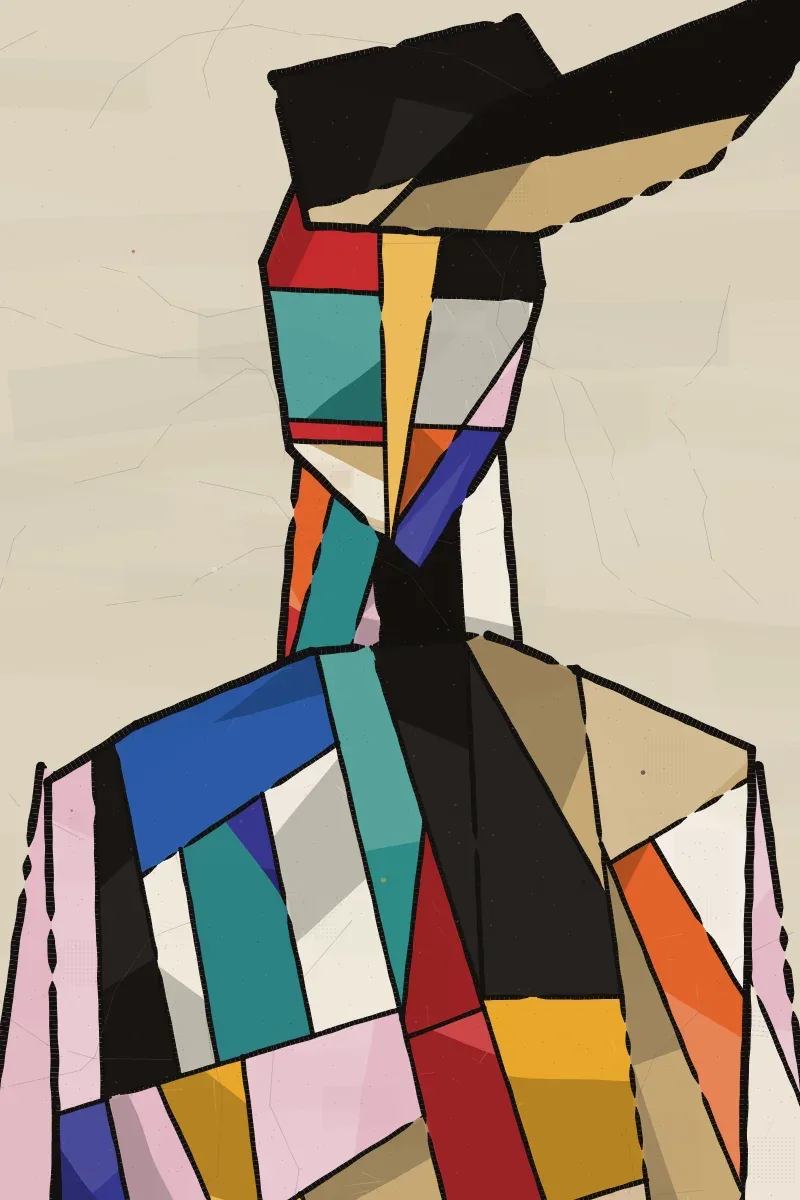
Torn Effigy
Lumen & Logic
A cubo-figurative bust on trowelled cream plaster, cut from painted paper and outlined in a dry black brush. A seeded figure — crown masses, a tapered head, a neck, a wide shoulder mass and descending arms, cropped hard by the top and bottom edges — is carved region by region into flat angular facets by a recursive guillotine that keeps splitting whichever facet is largest and cuts along the region's own axis, so each region ends up with one dominant plane and a scatter of smaller wedges, and no cut ever runs on into the region beside it. Every facet is then filled as a scrap of torn paper rather than a flat colour: sub-patches of related ink divided by ragged, small-scale torn edges, faint print ghosts of blocks and dash-rows on the pale scraps, pale scuff strokes, a dark speck field and a lifted band of lighter ink just inside each boundary, all pitched low enough that the facets still read flat at a distance. Colour is a flat seeded assignment with no light model anywhere — neutral papers through much of the figure, near-black concentrated in the crown, and orange, saffron, crimson, cobalt, violet and teal through the rest — so the picture reads as pasted scraps and never as a shaded solid. Over every facet boundary and around every region runs the piece's loudest mark: a heavy black brush line whose width breathes along its length, whose centreline wobbles, which opens short tapered gaps where the brush skipped, and which runs half again heavier on a silhouette than on an interior seam. A face is made of four facets and nothing else — a long tapering nose wedge, a deep-toned mouth patch, a jaw seam throwing one cheek into dark inks — with no eye drawn anywhere. Hairline cracks, specks and stray colour flecks are laid over figure and ground alike at the end, so the whole sheet reads as one worked plaster surface rather than as a collage pasted onto a backdrop.
- Medium
- Generative algorithm, archival pigment print
- Dimensions
- 60 × 90 cm