Tressure
Lumen & Logic
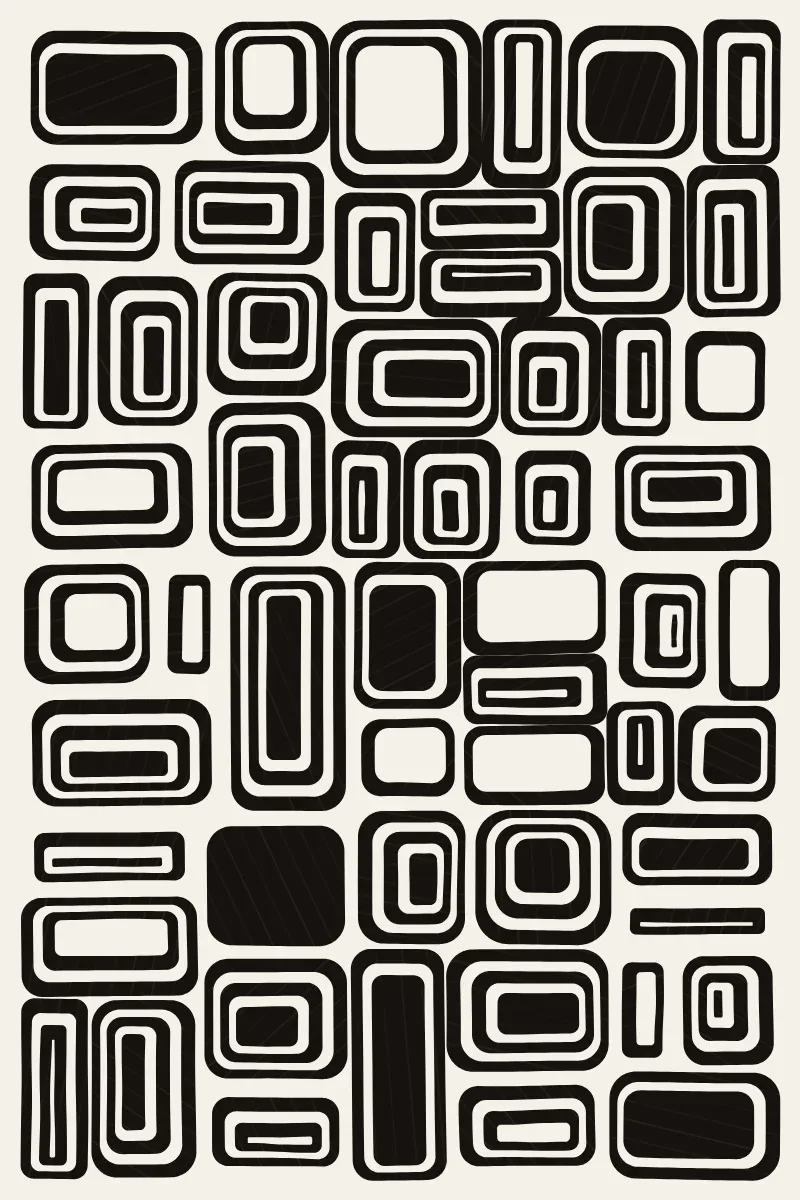
A sheet packed with nested rounded rectangles in marker, after a hand-drawn page of concentric black frames on white paper. A rounded rectangle is a box inflated by a corner radius, and that family is closed under erosion by a disc in closed form — the box comes in by the step, the corner comes in by the step — so a nest is two subtractions per band with no polygon clipper, no offsetting library and no sampling error anywhere. Erosion moves every point of a boundary inward along its own normal by the same distance, which is why the bands come out the same width all the way around a shape and in a cell four times bigger; scaling, the obvious alternative, would carry a band three times thicker on the long sides of a 3:1 cell than on its short ones. The step is the width of the marker and belongs to the sheet rather than to the cell, so band count is an output and never a setting: a big cell carries many bands and a small one carries two, at identical width, and every nest terminates on its own when the next erosion would empty the shape. The corner radius is floored rather than merely subtracted, because a hand rounds every corner at whatever size it is drawing — which keeps the corners proportionally round all the way in, makes a long thin cell nest into slots forever, and pinches the band slightly at the corners exactly as the reference does. Nothing is stroked: the fills are laid down outermost first, ink over paper over ink, each covering the whole interior of its shape, so a frame is the part of one fill the next does not cover, the black line the eye follows is the paper showing through, and a solid blot in the middle of a nest is simply the last fill when the count comes out odd. The cells are a guillotine partition that always cuts the longer side, and each one insets its shape by one global mean with a wide spread, so neighbouring masses fuse where two insets both land small — with no adjacency test anywhere. A coherent field over (position around the outline, band index) bows the sides and leans consecutive boundaries together instead of fraying them, each nest tilts a degree or two as a unit, and each shape is nudged off its parent so a frame reads thick at the top and thin at the bottom. The element is a knob — rounded rectangles, stadium slots, sharp rectangles, chamfered boxes, or a mixture — and it is nothing but the list of convex cores the same operator runs on.
- Medium
- Generative algorithm, archival pigment print
- Dimensions
- 60 × 90 cm